Monday, February 3, 2014

Don't Fear Food!

Last week I had the opportunity to travel to St. Louis to attend a training program for the CommonGround movement. CommonGround is a volunteer group of farm women whose mission it is to share their family farming operations and how they raise your food. Our #hashtag for this conference was #dontfearfood14 thus the title of this blog. I met some really awesome farm women whose mission in life is to raise healthy families and grow healthy food.

In the midst of some heavy PR campaigns from corporate folks who have probably never set foot on a farm, portraying farms to be something their not, here are the authentic family farms sharing their lives with you so that as consumers you can be confident in the foods you buy. #DontFearFood

Katie Olthoff is an Iowa turkey farmer who blogs at:


Wanda Patsche is a Minnesota hog and grain farmer and blogs at:


Kristin Reese is an Ohio sheep farmer, owns "Local Flavor Foods" catering and blogs at:


Christy Wright is a Delaware produce grower and blogs at:


Katie Pinke is from a 5th generation North Dakota farm family and blogs at: 


Sarah Ross is an Iowa farm mom who blogs at:

These are just a few of the farm women I've met who are CommonGround volunteers and are open and sharing their stories with you the consumer. There are many, many others! Our doors are open, our stories are real, and we can share with you how your food is grown or raised and why you
#DontFearFood!

Thursday, January 23, 2014

The Daniel Plan: Gluten, Wheat, & Celiac

Daniel 10:3 - "I ate no rich food. No meat or wine crossed my lips, and i used no fragrant lotions until those 3 weeks had passed." (NLT)

I've been a fan of Pastor Rick Warren of Saddleback Church for a number of years. His book A Purpose Driven Life guided my post-graduate degree decisions back in 2003. So when I found out he was publishing a "40 days to healthier living" book, I ordered it so I could continue to grow both spiritually and healthy. Being a Registered Dietitian, I have a weakness for these types of books, my shelves are cluttered with them. When it arrived, I of course went first to the "Foods to Lose" chapter which I opened with trepidation because I truly wondered which foods readers were going to be advised to "lose".

As a farmer, I'm a stickler for facts about agriculture and am tired of folks not in farming, spouting half truths and outright lies about agriculture to further their own agenda or line their own pockets. . If the book misfires in "foods to lose", then its pretty much over...

and indeed, it was over for The Daniel Plan.

Here is why professionally as a farmer and an RD, I'm returning The Daniel Plan.

"The heirloom biblical wheat of our ancestors is something modern humans never eat. Instead, we eat dwarf wheat, the product of genetic manipulation and hybridization, that created short, stubby, hardy, high-yielding wheat plants with much higher amounts of starch and gluten."

This is flawed for a couple of reasons:

1. USDA researcher Donald Karsada published in the Journal of Agricultural and Food Chemistry and analysis of historical wheat protein data which show that there has been no significant increase in wheat gluten.His research publication is linked here: Can an Increase in Celiac Disease Be Attributed to an Increase in the Gluten Content of Wheat as a Consequence of Wheat Breeding? Since 1925 to current data, wheat protein has averaged 10-18%.

NPR featured a show on this topic back in the fall which can be found here: Doctors Say Changes In Wheat Do Not Explain Rise Of Celiac Disease

2. USDA's National Small Grains Collection reports that both heirloom and modern wheat varieties have straw lengths ranging between 12" and 60" in length.

Some other facts about wheat, wheat intake, and gluten:.

In fact wheat consumption has declined from 2000 to 2012.

Source: USDA Wheat Year Book, Table 29


In addition, the premise that wheat consumption has contributed to obesity is also flawed. The table below shows peak wheat consumption  in the late 1800s, when, if wheat caused obesity, we would have been at our heaviest.
Source: Kasarda DD J Agric Food Chem. 2013 Feb 13;61(6):1155-9.

So what's the real cause of our obesity crisis? Calories! We're eating over 600 calories a day more than we were 4 decades ago!

Source: Dr. Julie Miller Jones
So look again, the first chart is USDA data showing the decline of wheat consumption and the 3rd chart is showing increasing calories since 1970. Still think its wheat?

Research shows whole grains have been associated with lower abdominal fat. The Framingham Heart Study (n=2834) compared visceral adipose tissue (VAT) to whole grain consumption and found that whole grain consumption lowered the amount of visceral fat. Visceral fat is the "cushion" around your vital organs but also is the fat that accumulates in excess in your abdominal area (think apple versus pear shaped). So think about the difference between whole grain and refined grain products. The difference in refining isn't changing the gluten in the wheat, it is changing the fiber content, while the processing into cookies, donuts, etc... adds fat and calories.

Source: McKeown et al. Am J Clin Nutr 2010; 92:1165-71
The lowest visceral fat noted in the front center column are those people who at 2 enriched and 3 whole grains daily.

But here was the refund real clincher for me - The book then goes on to say:

"The dwarf wheat grown in the United States has changed the quality and type of gluten protein in wheat, creating much higher gluten content, and creating a super-gluten that causes celiac disease and autoimmune antibodies."

Let me repeat that - the books specifically says "creating a super-gluten that causes celiac disease" (page 123)

I was done. I closed the book and was so utterly disappointed that Pastor Warren would associate himself with such misguided medical information. i couldn't even read the rest of the book. Chapter 4 closed the book for me because of a simple but very wrong medical statement.  I GET that he wants his congregation and himself  to get healthy. I applaud their success and their efforts BUT hear me when I say GLUTEN DOESN'T CAUSE CELIAC DISEASE!

The National Institutes of Health - Digestive Diseases Center states that celiac is a genetic autoimmune disease. 97% of people with celiac disease have the HLA-DQ-2 or the HLA-DQ-8 gene which predisposes them to celiac. This does not mean they necessarily develop celiac but usually have some triggering event such as surgery, pregnancy, viral infection, etc... It is detected by a blood test and confirmed by an intestinal biopsy. Less than 1% of the US population has celiac disease. Additionally, there is wheat allergy which less than 1% of people have and gluten sensitivity which afflicts approximately 6% of the population.

Source: WSJ: Clues to Gluten Sensitivity

Different from the many gluten-free fad diets, celiac is a very serious medical condition requiring the elimination of gluten from the diet. But the gluten-free market is a $3 billion food market. Books like The Daniel Plan and others that misrepresent celiac do true disservice to the medical condition.

Finally, what is NOT covered in this "Foods to Lose" chapter is the fact that barley, rye, and triticale also contain gluten. One of the chapter's subtitles is "Is Wheat Dangerous? The Problem With Gluten" but then makes NO mention of the other grains with gluten. So is the problem gluten, or is the problem wheat? Because you can't talk about one without the other and then leave out other grains that contain gluten. This type of misinformation does the reader a real disservice.

I applaud Pastor Warren and the Saddleback congregation for their weight loss and their efforts to grow healthy and spiritually. We Christians are told in the Book of I Corinthians 6:19 & 20 that our bodies are temples of the Holy Spirit, that we don't own them, that we received them from God and should honor God through how we treat them. Each of our approaches may be different through diet, exercise and other choices we make that honor or dishonor God with the way we use our bodies. But we also honor God with the truth, and the truth is, there are too many factual errors about wheat, gluten and celiac disease in The Daniel Plan. It was truly disappointing for me as a fan of Rick Warren.

Biblical Daniel did not give up wheat or other whole grains. He did not go gluten-free.


Many thanks to Dr. Julie Miller Jones, PhD, LN, CNS for contributing her assistance and information to this blog. 

Sunday, December 29, 2013

The Myth About Seed Choice

I recently had a twitter conversation on a topic that seemed to perpetuate an urban myth - that farmers do not have a choice when it comes to planting seed or that seed companies "impose" their seeds on farmers, as if it is a dictatorship... Last time I checked, America was a pretty free country. Most people are able to make choices on what they buy at the store... So why would that be different for farmers?

As a family farm, we grow both GMO (we don't actually use this term but for the sake of this blog, am using it for the reader for whom it may be a descriptor) and non-GMO crops and choose our seed produced from a variety of different seed companies, buying directly from our neighbors, which frankly, is the whole point of the fabric of rural America. We support one another.


So far, we have received about a dozen seed catalogs, and I don't mean Burpee-type gardening catalogs. I mean commercial seed for farmers. Some are large seed companies, others are small regional seed companies. None of them "impose" their seeds on us. We have 100% freedom of choice. My husband and brother in law make those choices based on our own farm's performance records, recommendations by our seed dealers, data provided by companies who do research plots on our farm and in our region, and conversations with farmer friends. No corporation influences these choices. No pressure is applied from any company to secure our business. Absolutely no one "imposes" seed on our family farm. We have hundreds of seed choices in each of our crops- corn, soybeans, wheat, barley, tomatoes, hay, and green beans. We have 100% control over what gets purchased and planted.

So we have technology agreements? Absolutely. Both our GMO and non-GMO seeds have either technology agreements or proprietary restrictions from saving seed.  As Rob Wallbridge shares in his blog An Organic Farmer Walks Into Monsanto, even organic seed has proprietary rights and cannot be saved. Seed is not unlike publications that can be copyrighted to protect the author's work. There would be far fewer food choices. Regardless of the methods of seed development, we have many, many more choices as consumers as a result of plant breeding. It is not surprising or for that matter unusual for people outside of agriculture to protect the rights to their work, why should it be different for agriculture?

The seeds and varieties we choose to plant are based on the demand we have for the markets in our area. In our tomato crop, the cannery wants specific varieties for specific products so one Roma variety is grown for stewed tomatoes while another Roma variety is grown for tomato sauce. We grow for the needs of the cannery. Likewise for our tofu customers, they tell us which soybeans they prefer and we grown to meet their needs. Likewise for our winery customers, we grow the grapes they want to process into wine.

We are also "seed" growers meaning we grow specific varieties for companies that will be then sold as seed. Farmers who can grow seed-quality seed get paid a premium for growing this level of purity. These seeds need to be "IP" Identity Preserved - genetically consistent and true to their traits, of highest quality meaning they are uniform in size, shape, color, free of weed seed and contamination.

We also grow "public domain" seed which are seeds that can be saved. These are seeds developed mainly by Universities, which are dwindling in size and support for agricultural research.  These varieties need to be tested for vigor and germination in order to determine if they are viable for the next cropping year or if they should be used for livestock feed. We use public varieties of both wheat and barley for both the commodity market and our winter cover crops.

The bottom line is we as farmers have choice - what seed we buy, from which company, and what traits those seeds have. The only time we don't have choice is when we sit on our thumbs and don't order seed in time and end up with 2nd or 3rd choices.

Tuesday, November 26, 2013

"When your plow is a pencil..."

 In 1956 President Dwight Eisenhower said "Farming looks mighty easy when your plow is a pencil and you're a thousand miles from the corn field" in reference to federal farm programs being written by Washington policy makers whom he called "synthetic farmers behind Washington desks."

As farmers, we often feel as though those "inside the beltway" (ie: Washington DC), are out of touch with the realities of agriculture and the implications of the policies they formulate. Because we are only 75 miles from downtown DC, we often have government officials, international delegations, and out of state farm groups visit. Often its the opportunity to get out of DC and into the country. More often its to see what agricultural policy, regulation, research, and collaboration looks like on a busy family farm.

Most recently we had USDA Deputy Secretary Krysta Harden visit. She is NOT a synthetic farmer, she is a Georgia farm girl who "gets it." DS Harden visited our farm recently so that she could connect with the local needs of farm families. It is a way for her to stay connected to her roots and use that connection in federal policy development.  We talked state and federal regulations and policies that are of most concern for us: conservation, immigration, diversification, Farm Bill, and generational transition. She realizes that true farm sustainability requires that there be the next generation who wants to farm and is a big supporter of beginning and young farmer programs. At the same time, she recognizes that regulations and policies cannot be so poorly written and planned that they have a negative impact on the fiscal health of the family farm. What kid wants to take over a family farm that is losing money hand over fist because the regulators wrote economically damaging policy? Too often, regulations or policy that seem to make sense in "theory", have very little practical application on the actual farm and are damaging to the family farm. Formulating regulations ahead of sound, applied scientific evidence is poor policy development, the sign of a "synthetic farmer" who maybe has never stepped foot on a farm.

That's why Eisenhower's words still resonate today. Many policy makers use pencils without ever having operated a plow (nowadays, a no-till ripper or DMI... we don't even own a plow). The bottomline - they don't "get it" because they've never farmed or been exposed to farming. I applaud DS Harden for staying connected with the farmers she serves and with her roots to the rural community. We have many synthetic farmers in DC, but she is not one of them!

Left to Right: Alan, DS Krysta Harden, Hans, Me, our daughter.

Talking agricultural diversification in our vineyard.
Hans showing DS Harden the soil map of our research project in collaboration with the US Geological Survey, the U of MD, and the U of DE.

Demonstrating a "Veris" machine which detects soil electrical conductivity to evaluate soil particle size and develop precision management for that field.


An irrigation research project that has many collaborators collecting data.


Sunday, November 3, 2013

Top 10 Annoying Words About Agriculture

A few weeks ago, I emailed around a poll to my farm and Ag friends both near and far to ask them to give me their top 10 words that most annoyed them that are used in referencing agriculture and farming. I received a lot of interesting responses. There were many, many repeats which I have ranked in order from top to bottom. What it boils down to is that as a culture, we want everyone "in their place". We want to define the people whose opinions differ from ours and confine them to a box. Social media is littered with examples of people and organizations lumping together and defining those who hold different beliefs in a negative way. It is a way of stereotyping, generalizing, misrepresenting, and for some, the ulterior motive of spreading misinformation. Thanks to my friends who contributed.

Here are the results:

1. "BIG" - In the context of activist groups, "big" is a derogatory term linked to the perception that the majority of farms are corporate farms.Frankly, the term "big" used in this context sounds rather kindergarten-ish. It has little to do with size but more to the idea that family farms are small farms whereas big farms must be corporate. In fact, 96% of all farms in the US are family owned and operated.  Farms vary widely in size as USDA defines a farm as any entity generating $1000 or more per year. (Which includes my daughter's 4H projects I suppose). $1K sets the bar pretty low in terms of defining a farm.

My daughter's 4H livestock sheep & hog projects meet the $1000 USDA threshold to be defined as a "farm".
"Big" is also used negatively by some who insinuate that because "Big Ag' is seen through corporations, that some how we farmers are not able to make independent decisions about our family farms. That some how "Big Ag" dictates what we buy and what we do on our farms. We aren't beholden to any corporation. We like most consumers, look for quality and customer service. Those two elements dictate our purchasing decisions and who we do business with.

A good example of double-speak however, is Chipotle who started a "big" campaign to redefine itself as "small". Established in 1993, Chipotle has expanded to over 1500 restaurants and ranks 2nd only to Taco Bell in the Top 50 QSR (quick service restaurants) in the Mexican food segment. Chipotle's 3rd quarter 2013 profits increased 18% to $827 Million. Let's be clear, if there is "Big" in food and agriculture it is Chipotle, not the US farmers supplying them.

2. "Factory" - Activists now define climate-controlled barns as "factories". If you are defining animal agriculture by agenda driven documentaries such as Food Inc, then you have chosen to limit your perspective and specifically elected not to look for balance in the whys and where-fores of food production in the current day. Personally, my preference is to talk to farmers, and not just the ones I perceive I am going to agree with.
Photo Credit: Edwin Remsberg
On a recent farm tour, someone remarked to my friend Jen, who is a hog farmer, how much extra space there was in each of her hog pens. If someone were to take a close up photo of the hogs to sensationalize animal spacing, the hogs would look packed together. Selective photography (and photoshop)  is a method used by some to spread myths about farming. In reality, the term "pig pile" comes from their natural preference, in barns or outside, to pile together to sleep.

3. "Industrial" - in modern agriculture, industrial is a word used to demonize progress and technology. Efficiency is apparently acceptable in other sectors, but not in farming. Not all that long ago, we as consumers did not have microwaves, dishwashers, smart phones, remote controlled - (fill in the blank), home computers, the Internet, etc.... We as consumers have adopted significant amounts of modern technology in our daily lives. Farmers have done the same. So if farmers are industrial through use of technology and efficiency, then we as consumers must be "industrial" too, right? I mean if the shoe fits, wear it! So do we all want to go back and stop using our technology so that agriculture will no longer be "industrial"?

A "combine" is named such because in one piece of equipment it combines the tasks of reaping and threshing, 2 vocabulary words foreign to most people today.

4. "Douse" - A word used to describe pesticide application. This is the type of rig used to apply pesticides and fertilizer. There is a fine mist (which in this pic happens to be fertilizer) guided by our GreenSeeker to apply only what the crop needs. Our family eats what we produce. Agricultural inputs are expensive. Why would we "douse" anything we grow with pesticides or fertilizer? Our approach is to look at the soil and plant health and apply what is "prescribed" from scouting and soil and tissue analysis. Much like your visit to the doctor, farmers diagnose and treat their crops according to their health and well being.


5. "Pump"- The word "pump" made the list thanks in part to Panera Bread's failed @EZChicken antibiotic campaign that illustrated in cartoon manner, chickens being injected with antibiotics and that farmers who use antibiotics are lazy. "Pump" really goes in line with the word "douse" as in every thing farmers do, we're believed to do to the excess. Any good business person will tell you that makes no sense whatsoever, but I suspect most of those who throw these terms around have never run their own businesses. Its easy to criticize someones business when your paycheck is funded by "unnamed donors" to a non-profit.

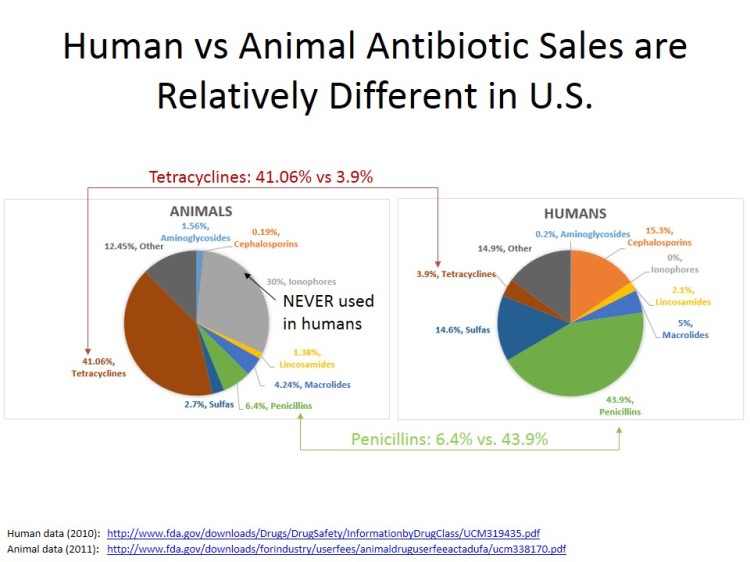
Earlier this year, the FDA had to issue a response to the Environmental Working Group's interpretation of an antibiotic resistance report..  The fact of the matter is, judicious antibiotic use is an issue for everyone and finger pointing does little to further the conversation. We don't like the finger pointed at ourselves but let's face it, human users of the health care system and those who prescribe antibiotics are as much at fault if not more so than farmers. How can I say that? This article from the Wall Street Journal discusses human prescriptions of antibiotics. And this report from the CDC shows which diseases and pathogens are most associated with antibiotic resistance, the majority of which are not farm related.

Human vs Animal Antibiotic Sales are Relatively Different v2
Infographic credit: Dr. Scott Hurd, DVM

6.  "Corporate"- as I said in #1, the majority of farms in the US are family owned and operated. They may vary in size, and they may be "incorporated" for tax purposes (C or S Corp) and for liability protection (LLC for example). I'm not a fan of Mother Jones, but they recently wrote an article confirming this fact. In terms of farms owned by corporations dictating the actions of the farmer, its pretty much a myth.

Infographic Credit: CommonGround 

7.  "GMO/Frankenfoods" - Wow, this one is hot in social media these days. One of the prevalent anti-GMO claims is that the foods made from genetic engineering (GE) technology haven't been studied and are not safe. A study in the journal Critical Reviews of Biotechnology looked at a decade of research on "GMO" foods and found no credible evidence that GMOs threaten health or safety of humans or the environment. A review of the study can be found here.

GMO describes what humans have done for centuries - domesticate, modify and improve the traits of plants for a specific use, such as tomatoes, corn, potatoes and the majority of foods we consume on a daily basis. Activists use the term "GMO" and "Frankenfoods" to define foods produced through a specific technology and use it as a means for fear-based marketing. Here is a good blog about fear-based food marketing by DairyMoos.

Selling Fear1
Photo Credit: DairyMoos

8.  "SuperWeed" -Let me just say it like it is.... Weed resistance is not a genetic engineering issue, it is an agronomic issue. Weed resistance to herbicides did not begin with RoundUp or with GE crops. The chart below is from the International Survey of Herbicide Resistant Weeds. It shows that resistant weeds were occurring well before GE crops were ever on the market. Notably, glyphosate/RoundUp which receives the most media attention, is 6th in chronological increase after 5 other classes of herbicides. You should also know that glyphosate/RoundUp did not come about because of GE crops. RoundUp was developed in the early 1970's and became commercially available in the US in 1976, 20 years before the commercialization herbicide tolerant crops. Its worth repeating - weed resistance is an agronomic issue, not a GE issue.


9.  "Shill" - while I consider "big" to be a rather kindergarten-ish word about Ag, "shill" is definitely a high school bully word. If you take the time to read the comments section of a polarized discussion on social media, often the first stone thrown is "you're a shill for Monsanto". Sometimes kindergarten is combined with high school and the commenter says "you're a shill for Big Ag". I wasn't directly called a shill, but the insinuation was there in the New York Times article I blogged about in Stay Calm & Farm On earlier this year. More recently, following an article I wrote for the Boston Review on Why Farmers Choose GMOs, I had the below twitter interaction with PoetryBoston who without knowing me, decided that I knew little about what I was talking about, following which they pointed out that I was one of Monsanto's America's Farm Moms of the Year for which I received prize money. I'm proud to have been selected by the American Agri-Women's Association as one of only 5 farm women in the US to be recognized. I make no apologies for the award nor am I embarrassed by it. It also does not influence my message which are data and results from our farm's experience as growers of conventional, organic and GE crops (yes simultaneously, and no... no longer organic. A topic for another day) Shill is intended to be derogatory and offensive. It shuts down any chance of meaningful conversation and civil discourse. It is possible to disagree without being disagreeable but that is rare if one spends any time reading the comments section.

From my @FarmGirlJen twitter page

10. "Agrarian" - Picture "American Gothic. The word "agrarian" brings a romantic notion of the days of old, and therefore, not being appreciative of where modern agriculture has brought our society as a whole. It demeans the profession that we love, and that somehow, all of society would be better off if we went back to subsistence farming. Agrarian, after all, is a society where the majority of citizens participate in farming, not the current 1.5% of the US population.

American Gothic by Grant Wood, 1930

My hope is that the conversation can become more civil by illustrating each of these words from a farmer's perspective. Farming is essentially a profession of many introverts and often an isolated job on a day to day basis. The story of agriculture and family farms has been told for us, often inaccurately. We as farmers don't all stand up and speak our minds publically about how we feel about these terms that are frequently used in reference to what we do.

People probably don't understand , we don't get to leave our jobs and go home at night. Our home is IS our farm and our job is a tapestry of our lives - of family, farm, and faith. Words that demean or misrepresent aren't words targeted just a me or my husband, but at my kids, my in-laws, and my 96 year old grandmother (who by the way does not resemble the woman above).

Its personal. You wouldn't want your family talked about that way.

We love our jobs, we love our farms, we love our family. We don't own a pitch fork.
We are today's modern farm family.

Photo Credit: Edwin Remsberg


Monday, October 28, 2013

Food, Farming, & Dietetics - Texas Style!

Last week I had the opportunity to speak at another farm tour for dietitians... this time in Texas! As part of the pre-conference activities for the Academy of Nutrition and Dietetics, the International Food Information Council invited dietitians from around the country to come a day early and attend a farm tour. Being both a dietitian and a farmer, they invited me to attend to lend my voice and experience to fellow colleagues. We got to visit Mowery Farms and learn about Curt Mowery's family farm operation, as well as discussion issues in agriculture with fellows from the Texas Farm Bureau, Missouri County Farm Bureau, and experts from Texas A&M University.

Although I know next to nothing about Texas agriculture (though more now that I did before!), I was on hand to share my experience both as a dietitian and as a farmer. It was interesting for me was Curt and I speak the same language, use very similar terminology, and have similar goals of being good stewards of the land we are fortunate to farm while being profitable enough to maintain the family farm for the next generation.

One of the topics we discussed as dietitians is though we are experts in the field of food and nutrition, the dietetics curriculum has very little content in the way of food production... as in growing food.  When I was in my undergrad program, "food production" meant learning how to prepare large quantities of food in a commercial kitchen, like a 1000 bed hospital. Food production to me now means how food is grown. That is an area of great disconnect both in training programs for various professionals, and in the general population who are generations removed from farming as a livelihood.

I'm a big cheerleader for farm tours. They are one of the best ways to inform consumers and professionals alike. Many thanks to Curt Mowery and team for engaging with the IFIC Farm Tour dietitians to help increase the knowledge and understanding of modern food production on today's family farms!

Below are a few pictures from our Texas farm tour of Mowery Farms!


Tuesday, October 22, 2013

40 Chances: Howard G. Buffett is my kindred spirit!

It has been a long time since I've used a highlighter to mark passages in a book that I'm reading. When I started reading Howard G. Buffett's "40 Chances: Finding Hope in a Hungry World", released today, I grabbed my yellow highlighter immediately. There was an immediate connection to a story teller with similar experiences as mine, the love of finding farming as a rewarding career, and the perspective one gains through working and experiencing life in developing countries.  Although he surely does not know it, (or appreciate it if he did), Buffett is my kindred spirit! He spoke my language throughout each of the 40 chapter of 40 Chances from policies and practices of US agriculture to policies and practices in places I've visited and worked. Buffett illustrates what's terribly wrong with food policies and yet leaves the reader hopeful, that a collective solution is attainable.

To read my book review, click here:


To learn more, visit 40 Chances or watch the video below: