Showing posts with label Conservation. Show all posts

Friday, September 7, 2012

Food Fight: Organic or Conventional?

This week a study from Stanford University created quite a buzz about our food and our food supply system. The study published in the Annals of Internal Medicine was entitled: "Are Organic Foods Safer or Healthier Than Conventional Alternatives?: A Systematic Review." (Smith-Spangler et al, Ann Intern Med. 2012;157(5):348-366). The authors looked at 45 years worth of published research comparing the nutritional differences between the two farming systems. The crib notes version of what they found was that there was no significant difference in nutritional value between organically produced foods and conventionally produced foods.

Likewise, the American Journal of Clinical Nutrition published a similar study in 2010 looking at over 50 years of research and reached a similar conclusion. (Dangour et al, Am J Clin Nutr. 2010: 92:203-10.)

My purely anecdotal conclusion from my own farming operation would concur with the results of these reviews. The nutritional value of what you eat is a direct result of the quality of the soil it is grown in. The soil quality is not dependent on a "farming system" ie: organic or conventional. Soil quality is contingent on the care and stewardship of the farmer farming the land. Care and stewardship are not "farming systems" but philosophies that work within both farming systems. Care and stewardship are not mutually exclusive to conventional farming. Visit a family farm and you will discover quite the opposite is true.

Soil condition and quality is a direct result of care and stewardship and will reflect the nutrients of that care and stewardship, as well as the nutrients that are inherent to that particular soil type. If a soil is low in boron, the food grown there is likely to be low in boron. If a soil is high in iron, the food is likely to be higher in iron than food grown in iron deficient soils. There is a direct correlation between the nutrients in the soil and the nutrients in your food grown from that soil regardless of whether that farmland is organic or conventional.

Some folks will say "well organic farmers take better care of their soils with organic practices." Let's take a closer look at that premise...

Wikepedia defines organic farming as "uses a variety of methods to improve soil fertility, including crop rotation, cover cropping, reduced tillage, and application of compost. By reducing tillage, soil is not inverted and exposed to air; less carbon is lost to the atmosphere resulting in more soil organic carbon. This has an added benefit of carbon sequestration which can reduce green house gases and aid in reversing climate change."

Jeez, sounds like my farm... which is conventional...

OK, let's look at those practices:

Crop rotation - yup we do that. We do that so that we build up the soils and reduce the likelihood of pest resistance by repeatedly planting the same thing in the same field year after year.
See this field of edible/tofu soybeans? Last year it was planted in corn.
Next year it will be back in corn or hay or tomatoes or green beans. We rotate our crops annually. Always have. Always will. Period. Conventionally.


Green manures & cover crops - yup, we do have and have for 40+ years.
Typically we plant cover crop wheat or rye. If we are looking to build up our soil fertility and tilth, we plant a mix of Austrian snowpeas, rapeseed, and crimson clover. If we are looking to break up compaction and tight soils, we plant tillage radish which you may also know as the Japanese delicacy Daikon radish. My husband says tillage radishes produce the most "mellow" soil. That's farmer terminology for really good soil quality. We plant the type of cover crops and green manures that the soil tells us it needs. Always have. Always will. Period. Conventionally.

No-till/conservation till - yup, we do that.
Good gosh this picture is older than I am and what a cutting edge contraption it was in its day. As I said in my last blog, this was a HiBoy cover crop seeder for no till planting. A practice started nearly 2 generations ago on our farm.

In this more current picture above is of the Comptroller of Maryland getting his first lesson in tractor driving, pulling a No-till ripper. He came for a visit so we taught him how to drive a tractor. No-till ripping is a conservation practice that breaks up the soil compaction 12+ inches below the surface with  minimal surface soil disturbance. Disturbing the soil surface creates the conditions for erosion. As land stewards, we want to keep our soil intact and in place so we do as little cultivation and tillage as possible.

Integrated Pest Management - yup we do that.
IPM is simple common sense practice. Essentially, you scout a crop looking for pests, whether insects or mildew or disease. IPM means you look for a certain level of disease or pest, also known as a threshold, choosing not to treat the problem if its below a certain threshold, or treating the problem if it reaches a higher threshold. Here my husband Hans is scouting soybeans looking for ear worms and stink bugs both of which attack the soybean pod and damage the crop. When we choose to spray, we may use an organic pesticide, or we may use a synthetic pesticide, it all depends on the level of the problem and the best way to correct the problem. When we do spray, we spray judiciously, using EPA approved organic or synthetic chemicals according to their label and making sure that the proper pre-harvest interval is followed so that no excess pesticide residue from either the organic or synthetic chemicals we use, remains on the crop.

So back to the food fight. We as conventional farmers practice very similarly to organic farmers. It is our goal to be constantly improving our soils through the many practices that are often credited to "organic" farming systems. We adhere to the pre-harvest intervals so that our buyers can trust the foods that we grow do not have unsafe levels of residues. As I've said in numerous blogs, my kids eat what we grow, and they are of utmost importance to me. If I wasn't comfortable feeding them what we grow, then we wouldn't farm the way we do.

There is not a food fight between us as farmers. We have good friends and neighbors who are certified organic. We all get along which is why it amazes me that this choice between organic and conventional is so polarized amongst consumers. As a farmer, I want you to support farmers of all kinds. If you choose organic foods, your supporting a farmer. If you choose conventional foods, your supporting a farmer. As a dietitian, I want you to eat healthy foods and know that you can do so from both organic and conventional. Despite the media frenzy around the study, I don't think this really is a food fight. It is your choice as a consumer and we are fortunate to have as many safe and healthy food choices as we do thanks to all the American farmers, organic and conventional.

Saturday, June 16, 2012

CNN Visits the Farm!

So this was an exciting week for us on the farm. We had the opportunity to host Dana Bash, Senior Political Correspondent for CNN on our farm. She was doing a story on the Farm Bill and wanted some farmer perspective. Due to our proximity to Washington DC, its not unusual for us to have reporters, foreign visitors, and other groups or individuals wanting to come talk about one aspect or another about farming and agriculture. Since the Farm Bill is currently being discussed in the Senate, it was timely for this interview to occurr. Dana Bash with CNN however, is probably the most well-known media person we've ever hosted on the farm, besides politicians themselves.

Dana Bash and her camera man interviewing my husband Hans.


We always get first time visitors to drive a piece of equipment.

Here Dana Bash does a good job helping us bale hay.

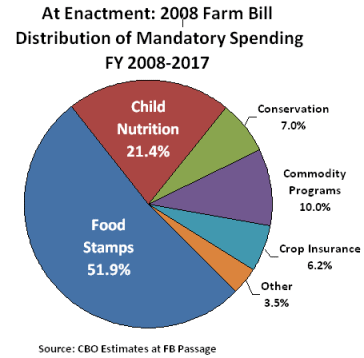
So you may be wondering what the big deal is about the Farm Bill? The Farm Bill is the policy and budget by which most all our food and agricultural production is based. It is a 5 year policy last revised in 2008 so 2012 is the year of its revamping and it is currently creating a lot of discussion with politicians and the media. The vast majority of the funds allocated in the Farm Bill are for food & nutrition programs for the poor,  underserved, and child nutrition like school lunch. The remaining funds go to farm payments, conservation practices, crop insurance, specialty crops, and other agricultural titles. As you can see from the pie chart below, food stamps and child nutrition make up 73.3% of the current 2008 Farm Bill spending.


One of the hot topics and what brought CNN to our farm is the issue of direct payments to farmers. You can see by the pie chart above under the Commodity Programs Title, that direct payments make up 10% of the current spending in the 2008 Farm Bill. Direct payments have been in the Farm Bill since the 1930's. Direct payments have for years been consider the safety net over which we farmers operate. In a vast number of years, the income from farming has often been below the cost it takes us to actually grow the crop. But to ensure a stable food supply, the federal government has essentially underwritten the "floor" of our food by providing direct payments to farmers. In the last 4 or 5 years, grain prices have been good and farm income has improved so there is less need for direct payments, thus the discussion of doing away with them while still providing a farm safety net through enhancing the crop insurance title. There are farmers on both sides of the coin with regards to the issue of direct payments. You'll hear in this video clip aired on CNN that we are in agreement that direct payments should not be part of the 2012 Farm Bill. Our opinion is by giving up direct payments is doing our part for fiscal responsibility to lower the US deficit. We do however strongly advocate for improved crop insurance. 2011 was one of our worst years on record and we would be deeper in debt if we had not purchased crop insurance coverage.

Click the link below to go to the story and CNN video clip:

CNN Farm Bill News Report From Our Farm

So if you watched the video in the link above, you heard my husband say we receive $35,000 annually in direct payments. What you didn't hear that got cut out of the interview was that he continued on to say that the direct payments we receive are used to implement conservation practices to improve the water quality of the Chesapeake Bay Watershed where we live. Let's be clear, direct payments are not pocket money for farmers to go spend. They are re-invested into the farming operation.

Here are some examples:
1. The insurance premium we pay out of pocket for our crop insurance policy on an annual basis surpasses the amount of the direct payment. That does not include our specialty crops like green beans, tomatoes, and winegrapes which are uninsurable in Maryland.
2. The conservation tillage equipment we purchased for protecting our soils from erosion and improving water quality was more than double and triple what we receive in direct payments.
3. The precision agriculture technology we purchased which decreases our fertilizer applications reducing the amount of nitrogen and phosphorus we apply to our fields surpassed what we received in direct payments.
4. Our fuel bill for our fleet of trucks and tractors to get the crops planted, tended, harvested and delivered well surpasses the compensation from the direct payment.

Farming is not a cheap business. It takes capital to grow your food. If you appreciate your safe, healthy, and economically priced food, it is due more in part to the smart efficiency of today's US farm families, and less due to the direct payments of the Farm Bill. That simply gives the Federal Government way too much credit. Let's give credit where credit is due, to the hard working farm families like mine who work to provide you with safe and nutritious food for your family, often inspite of governmental policy and regulations that make farming a challenge.

Sunday, April 22, 2012

Every Day is Earth Day On Our Family Farm

My daughter is great about asking questions that lead me to blog. (Remember, she was the one who ask about green french fries?) Today after church she says, "Mom, its Earth Day, why didn't we celebrate?" My response? "Honey, we're farmers, we celebrate Earth Day every day!"

OK, so that sounds rather corny, but really, that's the way it happened.

So let me tell you why our farm celebrates Earth Day every day. As stewards of the land, we have numerous farming practices that preserve and improve our soils and protect our environment.

Let me share some of our conservation efforts with you:

1. Our farm voluntarily took over 100 acres of farm land out of production and put them into conservation practices. These acres are adjacent to woods, ditches, ponds, waterways, and streams. This leads to less sediment and nutrients from getting into the water. It takes sensitive acres and takes them out of production protecting the larger environment around them. Not only does it improve water quality, but it also provides enhanced habitat for wildlife.

2. We installed grassy waterways and buffers larger than required. This enhances filtration of the water through the field to a wider buffer and further limits the likelihood of nutrients reaching the waterway.

3. Part of our farm is across from the town cemetery. The corner of that field is very low ground and not productive. We planted it in wildflowers and warm season grasses which when in bloom, will be free for the picking.

4. We take tissue samples of our crop foliage to determine the nutrient status of the crops (sort of like you getting a blood draw at the doctor's to check your cholesterol and other health indicators). This allows us to prescribe a "diet" for the crop that it needs, no more, no less. It allows us to target certain nutrients the plant needs. While many people take a multi-vitamin "just in case" (which by the way leads to higher nutrients in the water too), we feed a specific diet to our crops based on the results of the plant tissue analysis.

5. I have previously blogged about our new "GreenSeeker" technology. We used this technology recently in our small grains (wheat and barley). The GreenSeeker detects the chlorophyll in the plant tissue and tells us what the nitrogen needs of the plant are. We reduced our nitrogen application by 7-15 pounds per acre using this technology. This application is called "variable rate" meaning the technology senses when less is needed and cuts down on the amount of fertilizer applied as you travel across the field. This may not seem like alot of savings in fertilizer, but when you add it together with the total number of acres, it is quite a savings in the total amount of fertilizer applied.

6. RTK is an auto-steering system that we have in our tractors. The Earth Day advantage of RTK is that it guides our equipment with "sub-inch" accuracy, virtually eliminating all overlap in seed and fertilizer applications and preserving precious resources and enhancing our environmental control systems.

7. Cover crops are probably our largest contribution to land stewardship and therefore Earth Day. These are often called "green manure". We put over 1000 acres under cover in the winter. Cover crops are planted in the fall and are designed to take up any left over nutrients remaining in the soil after the previous crop is harvested. Instead of just leaving the field fallow for the winter, cover crops bind the nutrients and immobilize them in the plant. When we burn down the cover crop in the spring, those nutrients become available to the spring crop that we are currently planting.


8. No - Till is probably our second largest contribution to land stewardship and Mother Earth. 90% of our land is not worked up at all and the other 10% is either in permanent perenial crop such as the vineyard or we use conservation tillage equipment to prepare the soil. Using no-till, we do not work the ground up but plant directly into the plant residue left over from the previous crop. The Earth Day advantage of no-till farming is that you do not expose the soil to the risk of erosion.

So Happy Earth Day! Our family farm is celebrating it by continuing to be good stewards of the land we have, doing all that we can to leave it in better condition for the next generation.