It may be coincidence that both National Ag Day and National Nutrition Month occur both over the month of March but its not a coincidence that the issues of food and farming are so intertwined. The book "No More Food Fights!' is all about the conversation over food and farming, which is very polarized these days. Consumers don't feel farmers are paying attention to their needs or are suspicious of farming practices they are not familiar with. Farmers feel consumers don't understand agriculture and succumb too easily to media stories that don't paint an accurate picture.. Dietitians want to have science-based answers for consumers on how their food is produced. People in general are connecting back to the land now more than ever, or are connecting for the first time if their family lineage was always urban dwelling.
"No More Food Fights!" was published by Michele Payn-Knoper, CSP and Principal of Cause Matters. After I read the book, I knew I wanted to share it with my dietetic peers (the RD part of who I am) who could benefit from the variety of perspectives offered in this book. I did an interview with Michele and wrote a guest blog for Stone Soup of Food and Nutrition Magazine.
Here is the link to my interview with Michele and book review at Food and Nutrition Magazine:
I think for me as a farmer, one of my favorite quotes from the book is by Chef Renee Kelly,
"People are fascinated by farms but far removed with where their food comes from. They can't identify with farmers because food is so readily available that customers just assume it's easy to farm." Can I get an Amen from the farm side? I find this to be so true both in person and in social media. A lot of folks talking about farming as "experts" without ever having driven a tractor, milked a cow, weaned a pig, or spread manure (at least not literally anyways).
We all like to think we are experts with very little else to go on. When I was a grad student, I had college freshmen consider themselves "experts" after taking Nutrition 101. I've heard dietary cooks call themselves dietitians because they have been preparing food for so long. Likewise, I've been told "I have a large garden so I am familiar with farming." The one that always makes me laugh is "I know all about farming because as a kid, I spent summers on my Grandparents farm." REALLY? And four decades later, that makes them an expert on how to successfully sustain a family farm in today's environment?
The quote from To Kill a Mockingbird comes to mind - "You never really understand a person until you consider things from his point of view... Until you climb inside of his skin and walk around in it."
Or this somewhat well-known and similar saying : Don't judge a man until you have walked a mile in his boots, Don't criticize another person's work until you've tried to do it yourself; don't judge another person's life until you've been forced to live it. (Random House Dictionary of Popular Proverbs and Sayings, 1996) I would add, "don't assume farming is easy because food is abundant."
So for me, this book echoes my heart both as an RD and as a farmer. I hope you will pick it up and read it, and apply it throughout your conversations about food and farming.
I recently read a Facebook post that advocated for the closing of all grocery stores so that people would simply have to buy all their food from local farmers.... A response posted said "What a great idea!", so I started to really think about this in a literal sense, NO grocery stores! What do I as a farmer have to provide the millions of urban neighbors in the Baltimore/DC/Philadelphia metro region who need to be fed all year round?
The nearest grocery store to my house is 5 miles away. I get the majority of my food there because since I work on our family farm, I have little need to drive any further. All other grocery stores are 20 miles away. I tend not to go there unless I am needing to do other errands in that town. I highly value my time and my fuel, so the closest grocery store gets 99% of my grocery business. I don't traipse all over looking for "deals" or special items. I shop in one place and get what I need and get out. (By the way, I hate shopping, period). I would never drive 6 or 8 places to get "all" of what I would need to feed my family. I wouldn't go to the dairy farm, then the beef farm, then the pork farm, then the grain farm, then the fruit farm, then the chicken (broiler) farm, then the chicken (layers) farm, then the vegetable farm. I don't have the time, nor do most of these farms have direct to consumer sales in January or February.
Eliminating grocery stores throughout our country would leave a lot of hungry people in the winter. Below are pictures from my farm in Maryland in February along with 2 of my neighbor's farms. None of us have products to sell this time of year. While there are some farms who have year round greenhouses, there is not enough supply to replace grocery stores entirely. It would also mean a huge shift in infrastructure needed on local farms to support the damage that cars and customer traffic create. I personally prefer my farm without parking lots thank you very much, but if we need to feed everyone because there are no grocery stores, then paving over farm fields for parking lots would be necessary. After all, our lanes are not paved and people shopping for food after work in dress shoes don't like to step in mud or manure.
So what do we have growing in the winter? Below are some pictures of our current crops... or lack thereof:
Rotting tillage (daikon) radishes.... yum?? We do have folks come pick them,
obviously before they begin to decompose.
We grow these for cover crop, not for food.
Winter wheat crop, ripe for harvest in July, not now.
No grape harvest till September.
Our neighbor's peach trees... no fruit till July.
Our neighbor's blueberry bushes, no fruit till summer.
Which also means the Maryland Food Bank gets no food until harvest.
My neighbor's CSA has cabbage, kale, and leek seedlings...
but no harvest!
Our farm still has some corn, soybeans, and wheat in grain tanks. Theoretically, we could sell these to folks to make their own meal, flour, and tofu. My guess is, less than 0.05% of the US population has any idea of how to go about this. I also think that 99.5% of the US population would not want to make their own meal, flour, and tofu. Who frankly has that kind of time?
For 2 years after college, I lived in the Southern African nation of Botswana. We had no running water or electricity. We spent a lot of time on a daily basis hauling water from the community hydrant, collecting wood to start fires which we used to heat water and cook food, and pounding sorghum or corn into meal to use for cooking. This grinding process used a hollowed out tree trunk and solid, thick tree branch to pound the grain into meal. Sort of like a mortar and pestle. Incredibly time consuming and backbreaking and was a DAILY chore. Pounding grain, every day, day after day.
I would also miss the items that we have grown accustomed to in our diet such as orange or pineapple juice and bananas. None of these grow here in Maryland. While I "get" the local food movement, I don't believe the average American has any concept of what it would take to source all their dietary needs directly from farmers.Nor the time required to do so. Nor the resources required to do so. Not every one has a farmer's market nearby. Many farmer's markets couldn't support the mass of people who would need to be fed without grocery stores. And believe it or not, not all farmers want to be retail operations. How would I find enough people to buy the 8.5 million pounds of Roma tomatoes that we grew last summer? We'd never be able to sell 20 tractor trailer loads of tomatoes a day on the fresh. local market, which is why we grow them for a cannery, so that consumers eat them in tomato products year round!
Local food is great and benefits the local economy in season, but a number of our US growing regions do not support year round food production to the extent that it would replace grocery stores.
Support local farmers, in season! Remember that farmers also grew the items you buy at the grocery store so that we have a wonderful selection year round!
A couple weeks ago, I got to participate in my first "funding" meeting of the Maryland Grain Producers Utilization Board. I was appointed to the board in 2012 as a Director At Large and proud to say I am the first female farmer to serve on their board of directors!
The funding meeting was fascinating in that we had grant proposals to review every 15-20 minutes for an entire day and a half! We had nearly 65 proposals submitted for consideration and 18 hours to hear the presenters pitch why we should fund their project. On the 3rd day of our meeting, we awarded the funds based on their merit. It was quite a learning experience for me to see all that our check off dollars get spent on.
For those of you who do not know: "Check off" dollars are essentially a farmer-funded research and promotion account where farmers contribute a half of a percent of the net value of their grain at the time of sale. This money is pooled together and is administered by volunteer farmers who serve on commodity boards such as the Maryland Grain Producers. There is also soybean check off administered by Maryland soybean farmers and the famous "Got Milk" program is the dairy farmer funded program for dairy research and promotion.
The benefit of the check off program is that by pooling our money together, we can fund a lot more research and do more outreach and promotion than farmers could ever do on their own. Our Maryland Check off dollars help fund research that is Maryland specific and has a direct benefit to Maryland farmers and Maryland consumers. These funds went not only to University research projects like irrigation studies, nitrogen and phosphorus utilization improvements, groundwater quality projects and other agronomic research, but also to 4H and FFA programs, tractor school training, farm emergency training, and oyster recovery. Check Off dollars show what farmers can do working together for the future of agriculture and the benefits consumers receive from farmers funding their own research and promotion of the healthy foods we grow!
Below is the press release from the Maryland Grain Producers about our recent funding meeting.
Maryland Grain Farmers Award $1 Million in Grants and Elects New Officers to Board
The Maryland Grain Producers Utilization Board (MGPUB) has awarded over $1 million to organizations across the state to increase the profitability and viability of Maryland grain production, expand the utilization of grain, and to improve the understanding of agriculture. Grant funding is made possible through the Maryland grain checkoff program, whereby grain farmers contribute funds to support market development, education, and research.
“The checkoff program is all about farmers helping their own industry and those consumers that benefit from our products,” stated Marion Wilson, grain farmer and immediate past-president of MGPUB.“Funding projects for our region’s grain farmers means we get answers to address issues specific to Maryland, whether it be protecting crops from pests such as the stink bug, or finding the best farm management systems to improve our environment. This year we funded research projects that address both those areas, as well as ways to better market our products and educate consumers about Maryland-grown products.”
Funds for the 2013 grant period were allocated to projects in the areas of education ($312,675), research ($309,305), and market development ($420,272).Funding for projects that scientifically assess management practices and improve stewardship have always carried a priority.“Even though Maryland agriculture accounts for just 5% of the land use in the Chesapeake Bay watershed and contributes only 7.75% of the total nitrogen load, we want to do all we can to make as little impact as possible, while still providing for the food and fiber our consumers need,” comments Wilson.
At the annual funding meeting, Board members elected Tom Gannon as President of MGPUB.Gannon has been a farmer all his life and currently raises corn, wheat, soybeans and hay in Queen Anne’s County.Paul Spies of Cordova was elected Vice-President; Allen Davis of Galena was elected Treasurer; and Steve Ernst of Clear Spring was elected Secretary.
Maryland’s checkoff program has been in effect since 1991 and collects a half a percent of the net value of grain sold. The MGPUB administers the funds through a board consisting of regional grain farmer representatives and advisory members representing the University of Maryland, Maryland Department of Agriculture, and agribusinesses in the state. Funds are spent in the same proportion on each crop as they are received, and are specific to the needs of Maryland's grain farmers.
I had someone tell me the other day "it must be nice to be a farmer and have all that time off in the winter." Wow, that's sort of a sad impression but I guess not unexpected if one doesn't have anything growing in the fields and doesn't have livestock then we must sit around eating bon-bons right? I wish!
Once the equipment has been cleaned up and put away, we dive into the long neglected piles of paperwork that we didn't have time for during the growing season. While the winter is a bit "slower" as in we may actually sit down as a family in the evening and eat dinner together, I would say that we are finally able to keep "bankers hours" like a lot of people working "9-5" so to speak. We can do a regular 8 hour day, instead of a 12 or 14 hour day.
So what's going on on the farm right now?
1. Crop Insurance: compiling the paperwork and all the years of records that the insurance adjuster needs to verify our claim on wheat, corn, and grapes. Yes, we have claims in all 3 crops this year. Which is better than last year, when we had claims in 5 crops. Crop insurance requires demonstration of all your harvest records, amounts planted vs amounts harvested... for 4 years so they can determine your "average" to calculate your "loss".
2. Field records: particularly here in Maryland where nitrogen and phosphorus are regulated nutrients, all your applications must comply with your mandatory nutrient management plan so we dot our "i's" and cross our "t's" when it comes to filing our annual implementation report. Also, we are analyzing our field data to show what areas of various fields were productive, what areas were under-productive and what can we do in the coming season to improve our farming operation. Farmers do a pretty indepth "self-analysis" of how the year went and what they can improve upon it each and every year. We look at what we did to that field, from how we prepared the seed bed and what type if any conservation tillage we performed, to how many seeds we planted per acre, to what type and amount of fertilizer that field received, to the yield data where we try to connect what we did to the performance of the crop.
3. Bookwork: especially this year with the "fiscal cliff" we are trying to plan our family business so as to protect ourselves from the whims of the government and the policy makers who don't understand farming to begin with. Yes, I know that's a jab, but frankly, its the truth. Secretary Vilsack said in an interview recently on AgDay that the rural population is being marginalized. This is so true. We don't have the population base to influence policy makers or the votes. We have little representation in government particularly at the state and federal level who "get" rural America. So this bookwork I speak of is to plan our finances as best we can so that we can continue to farm inspite of the policymakers and government officials.
4. Volunteer service/ meetings: Here is a list of the agricultural organizations that my husband and I serve as volunteer board of directors: Maryland Soybean Board, National Association of Conservation Districts, Maryland Association of Soil Conservation Districts, Queen Anne's County Soil Conservation District, Maryland Farm Bureau Specialty Crops Committee, Queen Anne's County Farm Bureau, Chesapeake Fields Farmers Cooperative, Maryland Grape Growers Association, U.S.Wheat Foods Council, Maryland Grain Producers Utilization Board, and Queen Anne's County Right to Farm Committee, and the Governor's Commission on WineGrape Industry. Between December 1 and mid-March, we have multi-day board meetings or annual meetings to discuss the business of these organizations. This list doesn't even touch upon the community groups we are involved with or the groups who ask us to come be a speaker at one of their meetings because they want to hear from a farmer. Service to others is a core value for us.
5. Professional Development: yes, we farmers do pursue continuing education to further our knowledge about our businesses. As a dietitian, I'm required to get a certain number of credits in order to maintain my credentials. While farmers don't have a required nubmer of credits, we typically attend several courses or conferences to keep up with what's new in agriculture. My annual training has been to attend the Executive Women in Agriculture conference in Chicago where I get to learn with other farm women how to improve our family businesses. We try to find areas of learning that we would like to improve on such as no-till farming techniques or our knowledge of computer software that helps us be more technologically advanced on our farm. We are intentional about continuing to learn so that we are practicing continuous quality improvement on our farm.
6. Vineyard pruning: winegrapes get dormant pruned in the winter so we are actually in the field pruning our grapevines which prepares them for the next season's crop. Our goal is to have all the vines we have and those we are hired to prune, done by the end of March. This level of diversification helps us keep our employees working through the winter as well.
So in fact, we have very little slow time on the farm during the winter to eat bon-bons...
I can't take credit for this and in fact saw it posted on quite a number of social media sites. It may be tongue in cheek, but its unfortunately true when it comes to our government officials and those who make public policy with no background or experience on the topics they are deciding. It does tell us how imperative it is for average citizens to be proactive with your local, state, and federal representatives. Tell me what you think!
Acowboy named Bud was overseeing his herd in a remote mountainous pasture in Montana when suddenly a brand-new BMW advanced toward him out of a cloud of dust. The driver, a young man in a Brioni® suit, Gucci® shoes, RayBan® sunglasses and YSL® tie, leaned out the window and asked the cowboy, "If I tell you exactly how many cows and calves you have in your herd, will you give me a calf?" Bud looks at the man, who obviously is a yuppie, then looks at his peacefully grazing herd and calmly answers, "Sure, why not?" The yuppie parks his car, whips out his Dell® notebook computer, connects it to his Cingular RAZR V3® cell phone, and surfs to a NASA page on the Internet, where he calls up a GPS satellite to get an exact fix on his location which he then feeds to another NASA satellite that scans the area in an ultra-high-resolution photo. The young man then opens the digital photo in Adobe Photoshop® and exports it to an image processing facility in Hamburg, Germany .... Within seconds, he receives an email on his Palm Pilot® that the image has been processed and the data stored. He then accesses an MS-SQL® database through an ODBC connected Excel® spreadsheet with email on his Blackberry® and, after a few minutes, receives a response. Finally, he prints out a full-color, 150-page report on his hi-tech, miniaturized HP LaserJet® printer, turns to the cowboy and says, "You have exactly 1,586 cows and calves." "That's right. Well, I guess you can take one of my calves," says Bud. He watches the young man select one of the animals and looks on with amusement as the young manstuffs it into the trunk of his car. Then Bud says to the young man, "Hey, if I can tell you exactly what your business is, will you give me back my calf?" The young man thinks about it for a second and then says, "Okay, why not?" "You're a Congressman for the U.S. Government", says Bud. "Wow! That's correct," says the yuppie, "but how did you guess that?" "No guessing required." answered the cowboy. "You showed up here even though nobody called you; you want to get paid for an answer I already knew, to a question I never asked. You used millions of dollars worth of equipment trying to show me how much smarter than me you are; and you don't know a thing about how working people make a living - or about cows, for that matter. This is a herd of sheep. Now give me back my dog.
I'm so proud of our guys! Harvest time on any farm is a very busy season. Because of our diversification, we harvest 7 months a year, beginning in May, and ending, hopefully, in November. Soybeans are always the last crop to be harvested and it requires a lot of management on our part because we grow food/tofu grade soybeans, seed-grade soybeans, and feed-grade soybeans. (See my December 17, 2011 blog called "The Many Faces of Soy"). Equipment needs to be diligently cleaned between varieties and tracking which beans go into which bins and to which elevator. Its a bit of a juggle and something we try to get accomplished with minimal interruption.
As with any farmer, we are anxious to be finished with harvest as soon as possible. We no longer have to worry about weather and the hand that Mother Nature deals us once everything is "in the bin". That's why I'm so proud of our guys who interrupted harvest on Friday, November 23, 2012.
No, we did not go Black Friday shopping!
My husband, brother-in-law, myself, my son, daughter and nephew all joined together with others from our church and headed out on a mission trip 2 hours south to Deal Island, Maryland which was hit by Hurricane Sandy, but only recently (finally) declared a disaster area by the federal government.
Friday was a gorgeous day. A PERFECT day for soybean harvest... and our combines stood still. Unheard of! We knew that the needs of these folks in Somerset County were falling through the cracks and want to contribute to the relief effort. Their needs took priority over our harvest. We're so happy we could help.
There is a lot of need up and down the Eastern Seaboard. If you would like to contribute, you can donate $10 by texting "RESPONSE" to 80888 and reply "yes" to the text you receive from the United Methodist Committee on Relief. While there are many wonderful relief organizations, 100% of your donation to UMCOR goes to disaster relief and not administrative overhead. For more information or to make a larger donation, visit The United Methodist Committee on Relief
Some of the men who went on this mission trip, my husband in the center wearing a green sweatshirt and my brother-in-law on the far right.
My daughter & son loading a trailer full of wet, moldy furniture, carpet and other unsalvageable items.
Both are members of our church youth group.
Cleaning up downed trees was one of our main jobs and these girls work hard!
Our group of 18 did a good job tamping down the hump of roots left over from a fallen tree!
My nephew on the right spreading tar on a metal roof to help stop the leaks.
I call these "The Hurricane Kids" from our church youth group which I lead.
This is the 2nd hurricane relief mission trip we have done in as many years.
I have a tradition which is to cook my Thanksgiving turkey in a pretty non-traditional way. I charcoal grill it. I discovered this recipe 6 years ago while reading an issue of Yankee Magazine. The recipe was provided by Chef Geoff Gardner of Sel de la Terre Restaurant in Boston which has been named one of the top 100 new restaurants in the world by Conde Nast Traveler magazine. On a whim, I decided to try this recipe and it has changed my whole Thanksgiving turkey perspective! I LOVE the flavor this brine gives to the turkey and the moistness of the meat. Combined with the smokey grilled flavor, this is by far the best turkey recipe! I have tried this recipe with both store-bought and locally-raised turkey and it works well with either.
Marylander's have lots of options to purchase local turkey. I would encourage you to find a turkey farm near you that does direct to consumer sales and give them a try. Click here for the list of Maryland turkey farms: Find a Maryland Turkey Farm If your not a Marylander, google your state's department of agriculture which should have a listing of turkeys and other products that farmers in your area sell directly to consumers. Try to support your local farmers whenever possible!
Ingredients:
2 cups sea or kosher salt
2 cups sugar
2 T dried thyme
1 T dried rosemary
2 T whole black peppercorns
1 clove garlic, chopped
2 gallons water
12-14 lb turkey
5 bay leaves
1 orange sliced in half
1 apple sliced in half
In large stockpot, combine 2 gallons water, salt, sugar,
dried thyme & rosemary, peppercorns, and garlic. Bring to a simmer and stir
to dissolve salt; remove from heat. Fill sink with ice water, then lower pot
into sink to cook brine. When brine is cooled, submerge turkey in brine. Cover
and refrigerate for 24 hours.
Heat grill to medium (about 375-400 F). If using charcoal,
build fire on one side of grill. Remove turkey from brine and discard brine.
Rinse and pat turkey dry, place bay leaves inside cavity, rub skin with sliced
orange and apple, then place in cavity. Place turkey breast side up in a large
disposable aluminum baking pan and place on grill. (Blogger note: I also place the turkey in a cooking bag which I think helps keep the flavors and juices inside). If using charcoal, place pan
on opposite side of fire for full circulation of heat. Cover grill tightly. The grill does need to be placed out of direct wind or you will never be able to maintain the temperature of your grill. DO NOT place your grill in your garage or other enclosed space due to carbon monoxide poisoning!
Check turkey every 30 minutes and baste with any pan juices.
Charcoal grills may need to have extra charcoal added to maintain heat. Be
careful not to let grill flare up. Grill turkey about 2 hours or until meat
thermometer inserted into thigh registers 170 F. Let turkey rest at least
30minutes before carving.
I've been blessed of late to be asked to guest write or blog for a several media outlets. Earlier this week, my article on women in agriculture entitled "In the Company of Many" discussed the rise of the role of women farmers. It was published in a special section of our local weekly agriculture paper called The Delmarva Farmer.
To the women farmers, both those I've met and those I have not, I am thankful to be in the company of so many wonderful female farmers!
Here is a link to my article about women in agriculture. Enjoy!
I love it when I get to blog about real questions that real people ask me about farming. The other day, someone ask me why we wait until our crops are dead to harvest them. I had to think about what she meant before I could answer. I asked "What do you mean?" She replied "You know, how they all turn brown and die and then you harvest them."
I think she means corn that looks like this.
Or soybeans that look like this.
I understand the confusion. Most people who garden don't wait till their plants are dead to harvest the produce... but most people who garden do not grow grain. Grains or cereal crops are the "amber waves" of grain sung in "America the Beautiful". These crops may look "dead", but are actually "ripe" which is a better term than dead, and ready to be harvested.
Grain crops like corn, soybeans, wheat, barley, sorghum and others are harvested when ripened and for those plants, ripening means they have dried down and their green tissue has turned brown. Since these crops have a long storage life, they must be low in moisture in order to be held in large grain bins without going moldy. They have to be dry in order to have any shelf life for future use in a food or feed product. Consumers don't want moldy grain in their food, nor do animals care for moldy grain in their feed, not to mention the health risk to both if moldy grain is consumed by either.
In our combine, we have a monitor that tells us how many bushels per acre we are harvesting, how many acres we have harvested, and what the moisture content is of the grain we are harvesting. If we harvest grains that are too high in moisture and deliver them to a grain elevator, we get "docked" or penalized for high moisture content. We try to harvest at the right moisture level but occasionally have to run grain through a grain dryer to lower the moisture before we sell it. Drying grain gets expensive so we do our best to harvest at the right moisture.
Right now, corn is running 14-18% moisture. We get docked if the moisture is over 15.5%. We grow 104 - 112 day corn which means we can stagger our harvest dates over time so that the corn does not ripen all at the same time. This helps us plan the demand on our farm equipment and manage our resources more efficiently.
Today, we harvested corn which averaged 76 bushels/acre, less than half our normal average for dryland/unirrigated corn, due to the drought. This is the 2nd year of drought for us here in Maryland. Last year, 2011, we averaged barely 35 bushels/acre so despite not having a great year in 2012, we are thankful its not a repeat of the drought of 2011. Crop insurance is a critical component of the Farm Bill for years like this year and last. (and a future blog topic)
Soybeans must be under 13.5% moisture. Right now our soybeans look like this picture above. Soybeans are grouped into 13 different maturity groups, based on their adaptation to the climate and latitude. We grow late Group 3 to some early Group 5 soybeans. These beans are just starting to turn yellow and approach what we call "leaf drop stage" when the leaves turn brown and drop off, sort of like the first soybean picture above. Because of the high humidity and risk of hurricanes in our region, we harvest corn first and soybeans last. Last year, besides the drought, Hurricane Isabel flattened our irrigated corn, so between the drought and the hurricane of 2011, it was one of our worst years on record. In a good year, we will be harvesting soybeans through the end of November or early December because of a large crop to bring in. If we finish by Thanksgiving, we've had a not-so-good year, meaning there wasn't much to harvest.
And so now you know why grain crops turn brown... in case you ever wondered.
This week a study from Stanford University created quite a buzz about our food and our food supply system. The study published in the Annals of Internal Medicine was entitled: "Are Organic Foods Safer or Healthier Than Conventional Alternatives?: A Systematic Review." (Smith-Spangler et al, Ann Intern Med. 2012;157(5):348-366). The authors looked at 45 years worth of published research comparing the nutritional differences between the two farming systems. The crib notes version of what they found was that there was no significant difference in nutritional value between organically produced foods and conventionally produced foods.
Likewise, the American Journal of Clinical Nutrition published a similar study in 2010 looking at over 50 years of research and reached a similar conclusion. (Dangour et al, Am J Clin Nutr. 2010: 92:203-10.)
My purely anecdotal conclusion from my own farming operation would concur with the results of these reviews. The nutritional value of what you eat is a direct result of the quality of the soil it is grown in. The soil quality is not dependent on a "farming system" ie: organic or conventional. Soil quality is contingent on the care and stewardship of the farmer farming the land. Care and stewardship are not "farming systems" but philosophies that work within both farming systems. Care and stewardship are not mutually exclusive to conventional farming. Visit a family farm and you will discover quite the opposite is true.
Soil condition and quality is a direct result of care and stewardship and will reflect the nutrients of that care and stewardship, as well as the nutrients that are inherent to that particular soil type. If a soil is low in boron, the food grown there is likely to be low in boron. If a soil is high in iron, the food is likely to be higher in iron than food grown in iron deficient soils. There is a direct correlation between the nutrients in the soil and the nutrients in your food grown from that soil regardless of whether that farmland is organic or conventional.
Some folks will say "well organic farmers take better care of their soils with organic practices." Let's take a closer look at that premise...
Wikepedia defines organic farming as "uses a variety of methods to improve soil fertility, including crop rotation, cover cropping, reduced tillage, and application of compost. By reducing tillage, soil is not inverted and exposed to air; less carbon is lost to the atmosphere resulting in more soil organic carbon. This has an added benefit of carbon sequestration which can reduce green house gases and aid in reversing climate change."
Jeez, sounds like my farm... which is conventional...
OK, let's look at those practices:
Crop rotation - yup we do that. We do that so that we build up the soils and reduce the likelihood of pest resistance by repeatedly planting the same thing in the same field year after year.
See this field of edible/tofu soybeans? Last year it was planted in corn.
Next year it will be back in corn or hay or tomatoes or green beans. We rotate our crops annually. Always have. Always will. Period. Conventionally.
Green manures & cover crops - yup, we do have and have for 40+ years.
Typically we plant cover crop wheat or rye. If we are looking to build up our soil fertility and tilth, we plant a mix of Austrian snowpeas, rapeseed, and crimson clover. If we are looking to break up compaction and tight soils, we plant tillage radish which you may also know as the Japanese delicacy Daikon radish. My husband says tillage radishes produce the most "mellow" soil. That's farmer terminology for really good soil quality. We plant the type of cover crops and green manures that the soil tells us it needs. Always have. Always will. Period. Conventionally.
No-till/conservation till - yup, we do that.
Good gosh this picture is older than I am and what a cutting edge contraption it was in its day. As I said in my last blog, this was a HiBoy cover crop seeder for no till planting. A practice started nearly 2 generations ago on our farm.
In this more current picture above is of the Comptroller of Maryland getting his first lesson in tractor driving, pulling a No-till ripper. He came for a visit so we taught him how to drive a tractor. No-till ripping is a conservation practice that breaks up the soil compaction 12+ inches below the surface with minimal surface soil disturbance. Disturbing the soil surface creates the conditions for erosion. As land stewards, we want to keep our soil intact and in place so we do as little cultivation and tillage as possible.
Integrated Pest Management - yup we do that.
IPM is simple common sense practice. Essentially, you scout a crop looking for pests, whether insects or mildew or disease. IPM means you look for a certain level of disease or pest, also known as a threshold, choosing not to treat the problem if its below a certain threshold, or treating the problem if it reaches a higher threshold. Here my husband Hans is scouting soybeans looking for ear worms and stink bugs both of which attack the soybean pod and damage the crop. When we choose to spray, we may use an organic pesticide, or we may use a synthetic pesticide, it all depends on the level of the problem and the best way to correct the problem. When we do spray, we spray judiciously, using EPA approved organic or synthetic chemicals according to their label and making sure that the proper pre-harvest interval is followed so that no excess pesticide residue from either the organic or synthetic chemicals we use, remains on the crop.
So back to the food fight. We as conventional farmers practice very similarly to organic farmers. It is our goal to be constantly improving our soils through the many practices that are often credited to "organic" farming systems. We adhere to the pre-harvest intervals so that our buyers can trust the foods that we grow do not have unsafe levels of residues. As I've said in numerous blogs, my kids eat what we grow, and they are of utmost importance to me. If I wasn't comfortable feeding them what we grow, then we wouldn't farm the way we do.
There is not a food fight between us as farmers. We have good friends and neighbors who are certified organic. We all get along which is why it amazes me that this choice between organic and conventional is so polarized amongst consumers. As a farmer, I want you to support farmers of all kinds. If you choose organic foods, your supporting a farmer. If you choose conventional foods, your supporting a farmer. As a dietitian, I want you to eat healthy foods and know that you can do so from both organic and conventional. Despite the media frenzy around the study, I don't think this really is a food fight. It is your choice as a consumer and we are fortunate to have as many safe and healthy food choices as we do thanks to all the American farmers, organic and conventional.
Yesterday marked the beginning of green bean harvest on our family farm.
We diversified into growing green beans several years ago as a way to diversify the farming operation. This spreads our risk out over more crops as opposed to "putting all our eggs in one basket" so to speak. We were able to diversify into green bean growing because 1) there's a local market demand; 2) there is a regional distributor who sells the produce throughout the region that we as farmers do not have access to; and 3) and most importantly - we did not have to buy any new equipment or change any equipment in order to add green beans to our list of crops.
Point 3 is really important. Farm equipment is wicked expensive (yes I know that phrase dates me and perhaps even identifies that I'm originally from New England...). Diversification can be costly when you need specialty equipment. Too costly to justify when you consider the crop is a very small portion of the bigger picture. We grow these green beans because we can get them planted and tended throughout the season but we ourselves do not own and would not buy green bean harvesters to bring the crop in. We grow for a company that provides custom harvesting and custom hauling. That works for us.
Thus, while green bean harvest is going on, we're busy getting the combine ready for corn and doing final prep work in the vineyard to begin grape harvest. So the custom harvest and custom hauling also fits our farming operation this time of year when we just finished tomato harvest 2 days ago. Diversification is time consuming and creates a huge time crunch when crops like tomatoes, green beans, and winegrapes all start ripening at the same time. We can only be in so many places at one time.
Our green beans are hauled to a distributor. Sorted and graded and then shipped to the grocery stores in the Virginia, Maryland, and Washington DC area. If they do not "grade out" to be for the fresh market, they get sent to a cannery for canned green beans. While I support the concept of "buy local", if you're in the Maryland, Virginia, DC metropolitan area shopping at a grocery store this coming week, chances are if you buy green beans there, they will be from my farm. You are buying "local" without seeing my face.
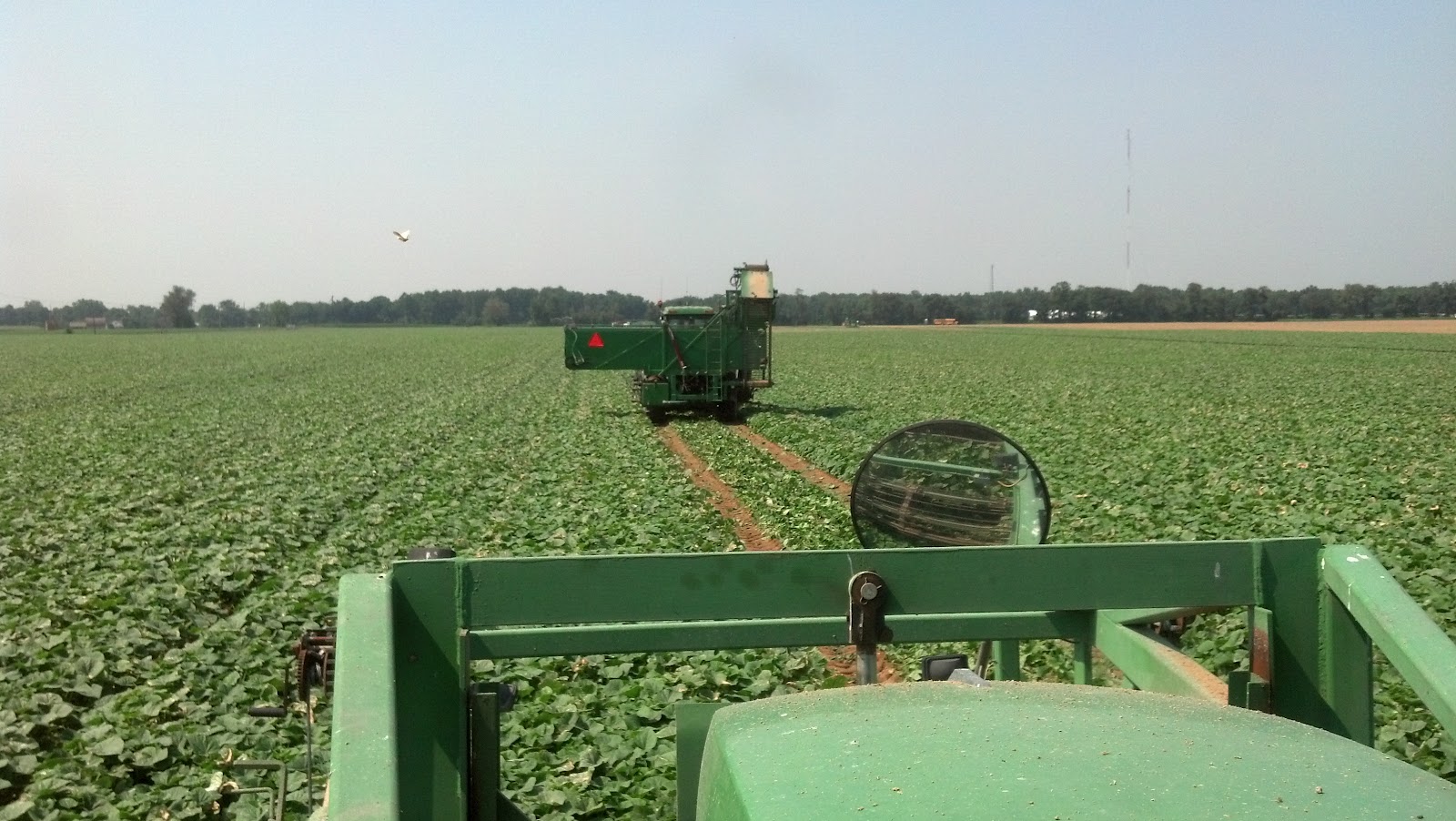
This is just an overview shot of our green bean field, with corn in the foreground. If you look closely, you will see 3 yellow dots in the field. Those are the custom harvesters. It will take them about 3 days to pick our 50 acres of green beans.
If you go back to my June 30th blog, you will see I griped about picking green beans by hand as a kid. This picture above is my preferred method of picking green beans... fresh from the field but done by machine and I can fill a bag in seconds out of the trailer!
I used the same recipe last night with these fresh green beans that I posted back in June only I substituted kielbasa for ham. I used up the last of my frozen turkey stock from last Thanksgiving and added a hefty teaspoon of Old Bay. It was delicious!
So buy more green beans this week. They're fresh from the farm!
One of the things I set out to do with this blog was to tell you about how different foods got from farm to table, or farm to fork, or farm to plate. Last week, I took the opportunity to visit my friend Hannah who grows cucumbers to see what cucumber harvest was like and to spend some time looking at a major summer crop - cucumbers.
Cucumbers ready for harvest on Hannah's farm!
Hannah and I spent 2 years together on the LEAD Maryland program, a 2-year agricultural leaders fellowship. It was a great opportunity to see the vast diversity of Maryland farming operations and agriculture across our state from the Atlantic Ocean to the Appalachian Mountains. We even got to travel through Vietnam, Hong Kong, and Taiwan together as part of LEAD Maryland's international agriculture seminar. . But enough about that, today we're talking cukes!
Hannah and her harvester....
Hmmm, sounds like the title of a children's book doesnt it?!
Hannah grows about 1000 acres of cucumbers each year. Because cucumbers have about a 45 day time period from when cukes are planted until they are ready for harvest, Hannah is able to double crop, meaning, planting and harvesting cukes twice, so it actually takes only 500 acres to grow 1000 acres worth of cukes. All of their cucumbers go for processing to local and regional pickling companies like B&G Foods in Hurlock, MD, Vlasic which has a processing facility in Delaware and Mount Olive which has a facility in Pennsylvania. Hannah's cukes are delivered to the processor by the tractor trailer load within hours of being picked and processed the same day. Cucumbers are highly perishable so they need to get where they are going and into the product they are being made to retain the highest quality. At the processors, they are placed onto sorting tables and graded and sorted by size to determine which pickle product those cucumbers will go toward. The cukes are made into various pickles if they make grade, and are processed into relish if they do not. She strives to grow pickle-grade cucumbers because she does not get paid for relish-grade cucumbers. Those are sort of deemed "seconds" and the farmer does not get paid for seconds.
Click the arrow in the image below here to watch my video of Hannah's cucumber harvest!
Keep in mind, here in the Mid-Atlantic, geographically speaking, the states are small, so Delaware is just a couples miles from both my farm and Hannah's farm. Likewise, the Pennsylvania state line is about 50 miles from my farm and maybe 75 for Hannah. If the common standard of 100 miles is used as a rule of thumb, "local" in the MidAtlantic region can include MD, DE, NJ, VA, and PA for many of our farms on the Eastern Shore.
OK, back to cucumbers. In several areas around the farm, Hannah keeps bee hives to help with the pollination of the cucumbers. They lease bee hives from a bee keeper in Maryland who comes and delivers hives according to how many hives are needed and moves the hives around from field to field according to the bloom time for the cucumber variety. They need hundreds of thousands of bees to help pollinate their cucumber crop. This is just one of several sets of hives that surrounded the field she was harvesting the day I visited. They were busy bees that day so I tried to stay out of their way!
Bee hives assisting with pollination.
So cucumbers for pickling are all machine harvested. It takes each harvester about an hour to pick an acre of cucumbers. Its a slow process moving the harvester up and down the field, harvesting cucumbers then transfering them to a trailer to be hauled away. The day I visited, they had 4 harvesters running. All family plus one employee. Hannah, her dad, her brother, and one employee were all driving harvesters while their mom kept them all running with supplies and local truck drivers hauled their harvest to the processing facility. They also grow sweet corn, corn for grain, and soybeans in addition to cucumbers. It is truly a family farming operation. It was a Sunday and I had to smile when her Dad came over the radio and announced that since they were all in the field and not at church that morning, that church was coming to them and they had to come up with something to use for an offering plate! They like us, try to avoid working Sundays if at all possible. But if the buyer is open and has a crew on hand ready to process cucumbers, they harvest on Sundays!
What a awesome sight! 100 acres of cucumbers being harvested!
Like I said in my last blog about our green beans, Hannah and her family are another example of how the grocery store is full of LOCAL products. You just don't see the farmer's face on the jar of pickles. I can't say enough times that you as a consumer should never assume that because you don't "see" the farmer at the grocery store, you should not mistakenly assume that food came from far away or was imported. Hannah's cucumbers and my green beans and tomatoes are both examples of family farms selling to regional processing companies to make products like pickles, relish, salsa, spaghetti sauce, canned vegetables and who buy from local and regional farmers in season.
So I as a pickle fanatic, came home with a couple bushels of cucumbers and immediately set to work to make pickles. I love to can. Its something my mom did, and her mom did. I guess its a generational thing. I wanted to process the cucumbers without heating them up to see if I could make crisper pickles than I have in the past. Here is the recipe that I used to processed my cucumbers:
Crock-Fermented Dill Pickles
Ingredients:
1/2 bushel fresh cucumbers
2-3 bunches fresh dill
10 garlic cloves
10 grape leaves
1 cup white vinegar
1 gallon water
1 cup canning salt
1 Tablespoon cayenne pepper (optional)
Directions:
1. Place spices and grape leaves in bottom of crock
2. Top with cucumbers
3. Mix water, vinegar and salt. Stir until salt dissolved. Pour over cucumbers.
4. Add extra dill, garlic, or cayenne pepper as desired.
5. Submerge pickles under water by placing a heavy plate on top weighted down by a jar full of water to be sure the cukes stay under the brine.
6. When a film appears, skim off and discard.
7. Taste test after 5 days.
The cayenne pepper was my personal addition which I love. The salt could actually be reduced to 3/4 of a cup. The original recipe called for 1 - 1 1/2 cups. I used one cup and still thought it was too salty. My daughter and I started taste testing after only 48 hours in the brine and became addicted. What I like about this recipe is that it is a "no cook" recipe which doesn't soften the cucumbers. They should be refrigerated once they have reach a point where you do not want them fermenting any longer. You could probably can them into a boil bath to preserve them which I will probably do to half the batch since I have 2 - 5 gallon crocks! I plan to refrigerate some and can the rest. These cukes have been pickling away now for a week and we have been munching on them all along. Maybe I won't have any left to can by the end of the summer. So far, they are still nice and crunchy. I'm thinking crock pickles are the way to go.
Its that time of year when fruits and vegetables are coming on in full force. One of the veges that there always seems to be a surplus of is green beans. This happens when you grow a large garden of them, as well as if like us, you grow between 50 and 150 acres of green beans annually. As a result, green beans are something that we never have a shortage of. When I open my deep freezer to see what to make for dinner, if its in there and its green...its a bean.
You'll notice this machine on the front page of my blog. This is a green bean harvester. We planted about 50 acres of green beans today, June 30th. They will be ready for harvest around August 30th. Green beans take about 60 days from planting till harvest. In a good year, we will harvest 200 bushels per acre. Thats a lot of green beans!
Green beans were one of the vegetable crops that was easy for us to diversify our farm because we can use the existing equipment that we already own. It would not be cost effective for us to grow green beans if we need to buy specialty equipment in order to grow them. We are fortunate because the company that we grow green beans for brings in the harvesters so our main job is to plant and tend the crop until harvest.
Green bean harvester picking fresh market green beans destined for the grocery store.
All our green beans are grown for the fresh market in the Washington DC, Baltimore, and MidAtlantic region. This is a perfect example of a family farm supplying fresh produce to the grocery store, but whose face you never see. Many of us produce growers grow for certain brands or certain companies but because they are supplied through a distributor, the customer at the store has no idea that the produce is actually locally grown by a family farm. I think that is one of the biggest mistakes customers make at the grocery, assuming that because its not from a farmer's market or farm stand, that it must have been shipped in from afar. In season, that generally is not true. Most grocers source locally and regionally in season.
There are specific uniformity, size, and shape requirements for fresh market green beans. If the beans don't make the grade for fresh market, then they end up at the cannery and are processed into canned green beans.
I have several very distinct memories of green beans growing up. Picking green beans was a chore my older sister and I hated. It was always hot and it was always tedious. We didn't appreciate the homegrown aspect of our parent's garden back then. It was just one more chore we had to do. Another is sitting by a farm pond snapping beans. Down the road was a neighbor who had a pond fed by an underground stream that was open to the neighbors to use. It was the pond where I took swimming lessons as a child. It was also the pond I remember snapping green beans with my mom and my 4H leader. Finally, my mom is famous for canning her "dilly beans". We LOVED these spicy pickled green beans as kids and it is one of the things I love to can when our green beans are ready. I taught my daughter this recipe and has entered them in our county 4H fair.
So I want to share with you a couple recipes to help use up that surplus of green beans that you have from your garden or maybe your neighbor dropped off on her way by (like mine did this evening). Like I said, we just planted green beans today, so I have none of my own but was the welcome recipient of a generous neighbor today!
Fresh picked green beans with our own farm raised ham and potatoe for dinner tonight! YUM!
Ingredients:
2 pounds green beans, snapped
4-5 cups chicken or turkey stock
4-6 potatoes, cubed
1 tsp minced garlic
1 pound cured ham, cubed
1 stick butter or margarine
salt to taste (or add Old Bay for some kick)
I use turkey stock left over in frozen containers from Thanksgiving. Stewing the carcass of the turkey will give me many quarts of stock to use throughout the year for various dishes. Bring the stock to a boil. Add the ham and let it simmer for 5-10 minutes. The stock plus the ham add a wonderful flavor to the veges. Add the potatoes, green beans, garlic, salt, and butter. Reduce the heat and simmer until the potatoes are soft. We eat this as a main dish even on a hot summer night.
My favorite green bean recipe as I said above is "Dilly Beans". This makes 8 pints.
Ingredients:
4 pounds of green beans, whole
1-2 cloves garlic per jar
1 head fresh dill per jar
1/4-3/4 cayenne pepper per jar depending on how hot you want them.
3 cups of water
3 cups cidar vinegar
1/4-1/2 cup salt
Stuff bottom of jars with seasonings. Add green beans lengthwise, leaving 1/4" head space from the top of the jar. Combine water, vinegar and salt in a pot and bring to boil. Pour boiling hot over beans, leaving 1/4" head space. Adjust caps loosely and process for 10 minutes in a boiling water bath. Let beans stand for at least 2 weeks before tasting to allow for flavor develoment.
This is all I have left of last year's Dilly Beans. Hope they last till the this year's crop comes in!
So this was an exciting week for us on the farm. We had the opportunity to host Dana Bash, Senior Political Correspondent for CNN on our farm. She was doing a story on the Farm Bill and wanted some farmer perspective. Due to our proximity to Washington DC, its not unusual for us to have reporters, foreign visitors, and other groups or individuals wanting to come talk about one aspect or another about farming and agriculture. Since the Farm Bill is currently being discussed in the Senate, it was timely for this interview to occurr. Dana Bash with CNN however, is probably the most well-known media person we've ever hosted on the farm, besides politicians themselves.
Dana Bash and her camera man interviewing my husband Hans.
We always get first time visitors to drive a piece of equipment.
Here Dana Bash does a good job helping us bale hay.
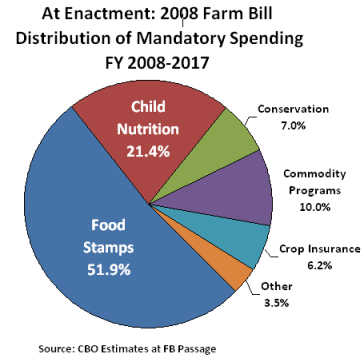
So you may be wondering what the big deal is about the Farm Bill? The Farm Bill is the policy and budget by which most all our food and agricultural production is based. It is a 5 year policy last revised in 2008 so 2012 is the year of its revamping and it is currently creating a lot of discussion with politicians and the media. The vast majority of the funds allocated in the Farm Bill are for food & nutrition programs for the poor, underserved, and child nutrition like school lunch. The remaining funds go to farm payments, conservation practices, crop insurance, specialty crops, and other agricultural titles. As you can see from the pie chart below, food stamps and child nutrition make up 73.3% of the current 2008 Farm Bill spending.
One of the hot topics and what brought CNN to our farm is the issue of direct payments to farmers. You can see by the pie chart above under the Commodity Programs Title, that direct payments make up 10% of the current spending in the 2008 Farm Bill. Direct payments have been in the Farm Bill since the 1930's. Direct payments have for years been consider the safety net over which we farmers operate. In a vast number of years, the income from farming has often been below the cost it takes us to actually grow the crop. But to ensure a stable food supply, the federal government has essentially underwritten the "floor" of our food by providing direct payments to farmers. In the last 4 or 5 years, grain prices have been good and farm income has improved so there is less need for direct payments, thus the discussion of doing away with them while still providing a farm safety net through enhancing the crop insurance title. There are farmers on both sides of the coin with regards to the issue of direct payments. You'll hear in this video clip aired on CNN that we are in agreement that direct payments should not be part of the 2012 Farm Bill. Our opinion is by giving up direct payments is doing our part for fiscal responsibility to lower the US deficit. We do however strongly advocate for improved crop insurance. 2011 was one of our worst years on record and we would be deeper in debt if we had not purchased crop insurance coverage.
Click the link below to go to the story and CNN video clip:
So if you watched the video in the link above, you heard my husband say we receive $35,000 annually in direct payments. What you didn't hear that got cut out of the interview was that he continued on to say that the direct payments we receive are used to implement conservation practices to improve the water quality of the Chesapeake Bay Watershed where we live. Let's be clear, direct payments are not pocket money for farmers to go spend. They are re-invested into the farming operation.
Here are some examples:
1. The insurance premium we pay out of pocket for our crop insurance policy on an annual basis surpasses the amount of the direct payment. That does not include our specialty crops like green beans, tomatoes, and winegrapes which are uninsurable in Maryland.
2. The conservation tillage equipment we purchased for protecting our soils from erosion and improving water quality was more than double and triple what we receive in direct payments.
3. The precision agriculture technology we purchased which decreases our fertilizer applications reducing the amount of nitrogen and phosphorus we apply to our fields surpassed what we received in direct payments.
4. Our fuel bill for our fleet of trucks and tractors to get the crops planted, tended, harvested and delivered well surpasses the compensation from the direct payment.
Farming is not a cheap business. It takes capital to grow your food. If you appreciate your safe, healthy, and economically priced food, it is due more in part to the smart efficiency of today's US farm families, and less due to the direct payments of the Farm Bill. That simply gives the Federal Government way too much credit. Let's give credit where credit is due, to the hard working farm families like mine who work to provide you with safe and nutritious food for your family, often inspite of governmental policy and regulations that make farming a challenge.


.JPG)
.JPG)
.JPG)