Showing posts with label local foods. Show all posts

Thursday, February 28, 2013

Eating Local Foods Exclusively Year Round?

I recently read a Facebook post that advocated for the closing of all grocery stores so that people would simply have to buy all their food from local farmers.... A response posted said "What a great idea!", so I started to really think about this in a literal sense, NO grocery stores!  What do I as a farmer have to provide the millions of urban neighbors in the Baltimore/DC/Philadelphia metro region who need to be fed all year round?

The nearest grocery store to my house is 5 miles away. I get the majority of my food there because since I work on our family farm, I have little need to drive any further. All other grocery stores are 20 miles away. I tend not to go there unless I am needing to do other errands in that town.  I highly value my time and my fuel, so the closest grocery store gets 99% of my grocery business. I don't traipse all over looking for "deals" or special items. I shop in one place and get what I need and get out. (By the way, I hate shopping, period).  I would never drive 6 or 8 places to get "all" of what I would need to feed my family. I wouldn't go to the dairy farm, then the beef farm, then the pork farm, then the grain farm, then the fruit farm, then the chicken (broiler) farm, then the chicken (layers) farm, then the vegetable farm.  I don't have the time, nor do most of these farms have direct to consumer sales in January or February.

Eliminating grocery stores throughout our country would leave a lot of hungry people in the winter.  Below are pictures from my farm in Maryland in February along with 2 of my neighbor's farms. None of us have products to sell this time of year. While there are some farms who have year round greenhouses, there is not enough supply to replace grocery stores entirely. It would also mean a huge shift in infrastructure needed on local farms to support the damage that cars and customer traffic create. I personally prefer my farm without parking lots thank you very much, but if we need to feed everyone because there are no grocery stores, then paving over farm fields for parking lots would be necessary. After all, our lanes are not paved and people shopping for food after work in dress shoes don't like to step in mud or manure.

So what do we have growing in the winter? Below are some pictures of our current crops... or lack thereof:

 Rotting tillage (daikon) radishes.... yum?? We do have folks come pick them, 
obviously before they begin to decompose. 
We grow these for cover crop, not for food.


Winter wheat crop, ripe for harvest in July, not now.


No grape harvest till September. 


Our neighbor's peach trees... no fruit till July.


Our neighbor's blueberry bushes, no fruit till summer. 


Which also means the Maryland Food Bank gets no food until harvest.


Photo: Welcome to the 2013 Growing Season.  Cabbage, kale and leeks representing.
My neighbor's CSA has cabbage, kale, and leek seedlings... 
but no harvest!


Our farm still has some corn, soybeans, and wheat in grain tanks. Theoretically, we could sell these to folks to make their own meal, flour, and tofu. My guess is, less than 0.05% of the US population has any idea of how to go about this. I also think that 99.5% of the US population would not want to make their own meal, flour, and tofu. Who frankly has that kind of time? 

For 2 years after college, I lived in the Southern African nation of Botswana. We had no running water or electricity. We spent a lot of time on a daily basis hauling water from the community hydrant, collecting wood to start fires which we used to heat water and cook food, and pounding sorghum or corn into meal to use for cooking. This grinding process used a hollowed out tree trunk and solid, thick tree branch to pound the grain into meal. Sort of like a mortar and pestle. Incredibly time consuming and backbreaking and was a DAILY chore. Pounding grain, every day, day after day. 

I would also miss the items that we have grown accustomed to in our diet such as orange or pineapple juice and bananas. None of these grow here in Maryland.  While I "get" the local food movement, I don't believe the average American has any concept of what it would take to source all their dietary needs directly from farmers.Nor the time required to do so. Nor the resources required to do so. Not every one has a farmer's market nearby. Many farmer's markets couldn't support the mass of people who would need to be fed without grocery stores. And believe it or not, not all farmers want to be retail operations. How would I find enough people to buy the 8.5 million pounds of Roma tomatoes that we grew last summer? We'd never be able to sell 20 tractor trailer loads of tomatoes a day on the fresh. local market, which is why we grow them for a cannery, so that consumers eat them in tomato products year round!

Local food is great and benefits the local economy in season, but a number of our US growing regions do not support year round food production to the extent that it would replace grocery stores.

Support local farmers, in season! Remember that farmers also grew the items you buy at the grocery store so that we have a wonderful selection year round!


Wednesday, December 19, 2012

Get to Know Your Farmer

I love it when I get asked to guest blog for another site.This month I was asked to guest blog for "Stone Soup", the guest blogging section of Food and Nutrition Magazine of the Academy of Nutrition and Dietetics I hope you'll read it. Its a remake of a blog I wrote called "Locavore" or "Globavore".  Its features some of my favorite  women farmers, who like me, are passionate about agriculture and the food they raise for consumers.

They, like me, won't have our faces on the products we provide at the grocery store, so I hope this helps connect the reader to the fact that of the plethora of food choices you have on the grocery shelves, the majority of it was grown by farm families like ours.


Saturday, August 25, 2012

Buy More Green Beans!

Yesterday marked the beginning of green bean harvest on our family farm.


We diversified into growing green beans several years ago as a way to diversify the farming operation. This spreads our risk out over more crops as opposed to "putting all our eggs in one basket" so to speak. We were able to diversify into green bean growing because 1) there's a local market demand; 2) there is a regional distributor who sells the produce throughout the region that we as farmers do not have access to; and 3) and most importantly - we did not have to buy any new equipment or change any equipment in order to add green beans to our list of crops.

Point 3 is really important. Farm equipment is wicked expensive (yes I know that phrase dates me and perhaps even identifies that I'm originally from New England...). Diversification can be costly when you need specialty equipment. Too costly to justify when you consider the crop is a very small portion of the bigger picture. We grow these green beans because we can get them planted and tended throughout the season but we ourselves do not own and would not buy green bean harvesters to bring the crop in. We grow for a company that provides custom harvesting and custom hauling. That works for us.

Thus, while green bean harvest is going on, we're busy getting the combine ready for corn and doing final prep work in the vineyard to begin grape harvest. So the custom harvest and custom hauling also fits our farming operation this time of year when we just finished tomato harvest 2 days ago. Diversification is time consuming and creates a huge time crunch when crops like tomatoes, green beans, and winegrapes all start ripening at the same time. We can only be in so many places at one time.

Our green beans are hauled to a distributor. Sorted and graded and then shipped to the grocery stores in the Virginia, Maryland, and Washington DC area. If they do not "grade out" to be for the fresh market, they get sent to a cannery for canned green beans. While I support the concept of "buy local", if you're in the Maryland, Virginia, DC metropolitan area shopping at a grocery store this coming week, chances are if you buy green beans there, they will be from my farm. You are buying "local" without seeing my face.

This is just an overview shot of our green bean field, with corn in the foreground. If you look closely, you will see 3 yellow dots in the field. Those are the custom harvesters. It will take them about 3 days to pick our 50 acres of green beans.


If you go back to my June 30th blog, you will see I griped about picking green beans by hand as a kid. This picture above is my preferred method of picking green beans... fresh from the field but done by machine and I can fill a bag in seconds out of the trailer!

I used the same recipe last night with these fresh green beans that I posted back in June only I substituted kielbasa for ham. I used up the last of my frozen turkey stock from last Thanksgiving and added a hefty teaspoon of Old Bay. It was delicious!

So buy more green beans this week. They're fresh from the farm!

Sunday, July 8, 2012

Picking Pickles!

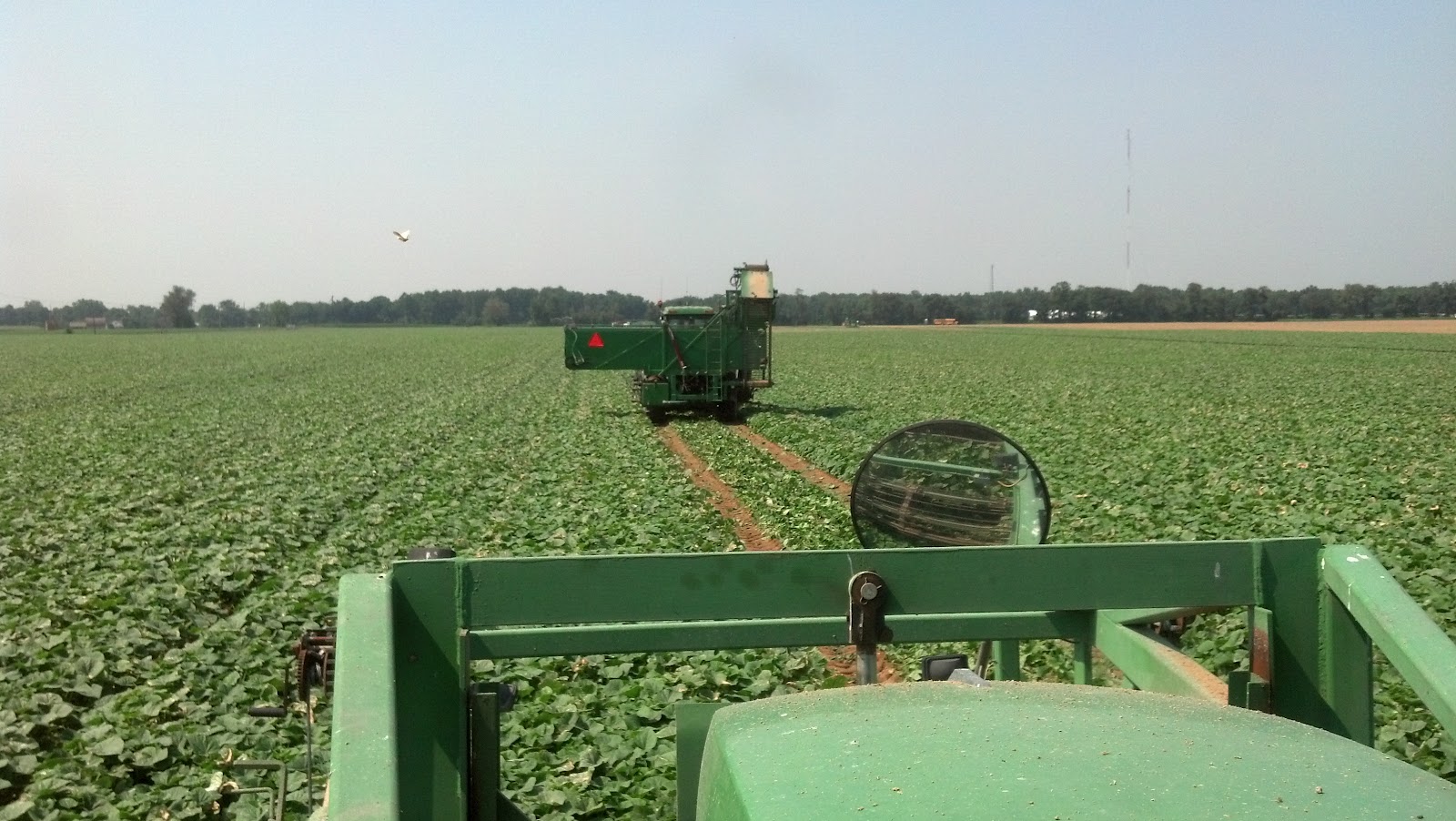
One of the things I set out to do with this blog was to tell you about how different foods got from farm to table, or farm to fork, or farm to plate. Last week, I took the opportunity to visit my friend Hannah who grows cucumbers to see what cucumber harvest was like and to spend some time looking at a major summer crop - cucumbers.

Cucumbers ready for harvest on Hannah's farm!

Hannah and I spent 2 years together on the LEAD Maryland program, a 2-year agricultural leaders fellowship. It was a great opportunity to see the vast diversity of Maryland farming operations and agriculture across our state from the Atlantic Ocean to the Appalachian Mountains. We even got to travel through Vietnam, Hong Kong, and Taiwan together as part of LEAD Maryland's international agriculture seminar. . But enough about that, today we're talking cukes!

Hannah and her harvester....
Hmmm, sounds like the title of a children's book doesnt it?!

Hannah grows about 1000 acres of cucumbers each year. Because cucumbers have about a 45 day time period from when cukes are planted until they are ready for harvest, Hannah is able to double crop, meaning, planting and harvesting cukes twice, so it actually takes only 500 acres to grow 1000 acres worth of cukes. All of their cucumbers go for processing to local and regional pickling companies like B&G Foods in Hurlock, MD, Vlasic which has a processing facility in Delaware and Mount Olive which has a facility in Pennsylvania. Hannah's cukes are delivered to the processor by the tractor trailer load within hours of being picked and processed the same day. Cucumbers are highly perishable so they need to get where they are going and into the product they are being made to retain the highest quality.  At the processors, they are placed onto sorting tables and graded and sorted by size to determine which pickle product those cucumbers will go toward. The cukes are made into various pickles if they make grade, and are processed into relish if they do not. She strives to grow pickle-grade cucumbers because she does not get paid for relish-grade cucumbers. Those are sort of deemed "seconds" and the farmer does not get paid for seconds.

Click the arrow in the image below here to watch my video of Hannah's cucumber harvest!


Keep in mind, here in the Mid-Atlantic, geographically speaking, the states are small, so Delaware is just a couples miles from both my farm and Hannah's farm. Likewise, the Pennsylvania state line is about 50 miles from my farm and maybe 75 for Hannah. If the common standard of 100 miles is used as a rule of thumb, "local" in the MidAtlantic region can include MD, DE, NJ, VA, and PA for many of our farms on the Eastern Shore.

OK, back to cucumbers. In several areas around the farm, Hannah keeps bee hives to help with the pollination of the cucumbers. They lease bee hives from a bee keeper in Maryland who comes and delivers hives according to how many hives are needed and moves the hives around from field to field according to the bloom time for the cucumber variety. They need hundreds of thousands of bees to help pollinate their cucumber crop. This is just one of several sets of hives that surrounded the field she was harvesting the day I visited. They were busy bees that day so I tried to stay out of their way!

 Bee hives assisting with pollination.

So cucumbers for pickling are all machine harvested. It takes each harvester about an hour to pick an acre of cucumbers. Its a slow process moving the harvester up and down the field, harvesting cucumbers then transfering them to a trailer to be hauled away. The day I visited, they had 4 harvesters running. All family plus one employee.  Hannah, her dad, her brother, and one employee were all driving harvesters while their mom kept them all running with supplies and local truck drivers hauled their harvest to the processing facility. They also grow sweet corn, corn for grain, and soybeans in addition to cucumbers. It is truly a family farming operation. It was a Sunday and I had to smile when her Dad came over the radio and announced that since they were all in the field and not at church that morning, that church was coming to them and they had to come up with something to use for an offering plate! They like us, try to avoid working Sundays if at all possible. But if the buyer is open and has a crew on hand ready to process cucumbers, they harvest on Sundays!


What a awesome sight! 100 acres of cucumbers being harvested!

Like I said in my last blog about our green beans, Hannah and her family are another example of how the grocery store is full of LOCAL products. You just don't see the farmer's face on the jar of pickles. I can't say enough times that you as a consumer should never assume that because you don't "see" the farmer at the grocery store, you should not mistakenly assume that food came from far away or was imported. Hannah's cucumbers and my green beans and tomatoes are both examples of family farms selling to regional processing companies to make products like pickles, relish, salsa, spaghetti sauce, canned vegetables and who buy from local and regional farmers in season.

So I as a pickle fanatic, came home with a couple bushels of cucumbers and immediately set to work to make pickles. I love to can. Its something my mom did, and her mom did. I guess its a generational thing. I wanted to process the cucumbers without heating them up to see if I could make crisper pickles than I have in the past. Here is the recipe that I used to processed my cucumbers:

Crock-Fermented Dill Pickles

Ingredients:
1/2 bushel fresh cucumbers
2-3 bunches fresh dill
10 garlic cloves
10 grape leaves
1 cup white vinegar
1 gallon water
1 cup canning salt
1 Tablespoon cayenne pepper (optional)

Directions:
1. Place spices and grape leaves in bottom of crock
2. Top with cucumbers
3. Mix water, vinegar and salt. Stir until salt dissolved. Pour over cucumbers.
4. Add extra dill, garlic, or cayenne pepper as desired.
5. Submerge pickles under water by placing a heavy plate on top weighted down by a jar full of water to be sure the cukes stay under the brine.
6. When a film appears, skim off and discard.
7. Taste test after 5 days.

The cayenne pepper was my personal addition which I love. The salt could actually be reduced to 3/4 of a cup. The original recipe called for 1 - 1 1/2 cups. I used one cup and still thought it was too salty. My daughter and I started taste testing after only 48 hours in the brine and became addicted. What I like about this recipe is that it is a "no cook" recipe which doesn't soften the cucumbers. They should be refrigerated once they have reach a point where you do not want them fermenting any longer. You could probably can them into a boil bath to preserve them which I will probably do to half the batch since I have 2 - 5 gallon crocks! I plan to refrigerate some and can the rest. These cukes have been pickling away now for a week and we have been munching on them all along. Maybe I won't have any left to can by the end of the summer. So far, they are still nice and crunchy. I'm thinking crock pickles are the way to go.

Thanks Hannah for sharing your farm with us!