Sunday, July 8, 2012

Picking Pickles!

One of the things I set out to do with this blog was to tell you about how different foods got from farm to table, or farm to fork, or farm to plate. Last week, I took the opportunity to visit my friend Hannah who grows cucumbers to see what cucumber harvest was like and to spend some time looking at a major summer crop - cucumbers.

Cucumbers ready for harvest on Hannah's farm!

Hannah and I spent 2 years together on the LEAD Maryland program, a 2-year agricultural leaders fellowship. It was a great opportunity to see the vast diversity of Maryland farming operations and agriculture across our state from the Atlantic Ocean to the Appalachian Mountains. We even got to travel through Vietnam, Hong Kong, and Taiwan together as part of LEAD Maryland's international agriculture seminar. . But enough about that, today we're talking cukes!

Hannah and her harvester....
Hmmm, sounds like the title of a children's book doesnt it?!

Hannah grows about 1000 acres of cucumbers each year. Because cucumbers have about a 45 day time period from when cukes are planted until they are ready for harvest, Hannah is able to double crop, meaning, planting and harvesting cukes twice, so it actually takes only 500 acres to grow 1000 acres worth of cukes. All of their cucumbers go for processing to local and regional pickling companies like B&G Foods in Hurlock, MD, Vlasic which has a processing facility in Delaware and Mount Olive which has a facility in Pennsylvania. Hannah's cukes are delivered to the processor by the tractor trailer load within hours of being picked and processed the same day. Cucumbers are highly perishable so they need to get where they are going and into the product they are being made to retain the highest quality.  At the processors, they are placed onto sorting tables and graded and sorted by size to determine which pickle product those cucumbers will go toward. The cukes are made into various pickles if they make grade, and are processed into relish if they do not. She strives to grow pickle-grade cucumbers because she does not get paid for relish-grade cucumbers. Those are sort of deemed "seconds" and the farmer does not get paid for seconds.

Click the arrow in the image below here to watch my video of Hannah's cucumber harvest!


Keep in mind, here in the Mid-Atlantic, geographically speaking, the states are small, so Delaware is just a couples miles from both my farm and Hannah's farm. Likewise, the Pennsylvania state line is about 50 miles from my farm and maybe 75 for Hannah. If the common standard of 100 miles is used as a rule of thumb, "local" in the MidAtlantic region can include MD, DE, NJ, VA, and PA for many of our farms on the Eastern Shore.

OK, back to cucumbers. In several areas around the farm, Hannah keeps bee hives to help with the pollination of the cucumbers. They lease bee hives from a bee keeper in Maryland who comes and delivers hives according to how many hives are needed and moves the hives around from field to field according to the bloom time for the cucumber variety. They need hundreds of thousands of bees to help pollinate their cucumber crop. This is just one of several sets of hives that surrounded the field she was harvesting the day I visited. They were busy bees that day so I tried to stay out of their way!

 Bee hives assisting with pollination.

So cucumbers for pickling are all machine harvested. It takes each harvester about an hour to pick an acre of cucumbers. Its a slow process moving the harvester up and down the field, harvesting cucumbers then transfering them to a trailer to be hauled away. The day I visited, they had 4 harvesters running. All family plus one employee.  Hannah, her dad, her brother, and one employee were all driving harvesters while their mom kept them all running with supplies and local truck drivers hauled their harvest to the processing facility. They also grow sweet corn, corn for grain, and soybeans in addition to cucumbers. It is truly a family farming operation. It was a Sunday and I had to smile when her Dad came over the radio and announced that since they were all in the field and not at church that morning, that church was coming to them and they had to come up with something to use for an offering plate! They like us, try to avoid working Sundays if at all possible. But if the buyer is open and has a crew on hand ready to process cucumbers, they harvest on Sundays!
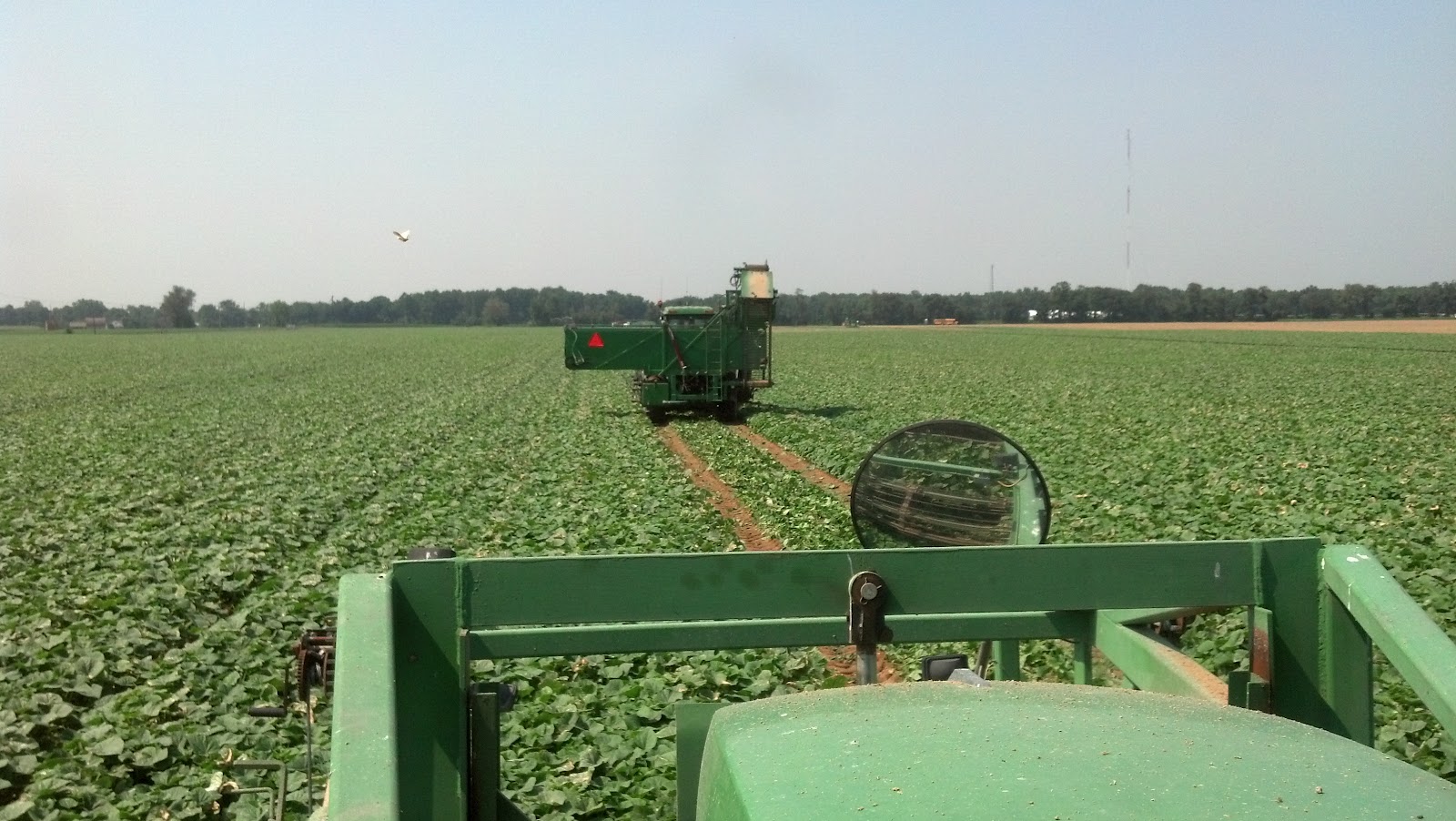

What a awesome sight! 100 acres of cucumbers being harvested!

Like I said in my last blog about our green beans, Hannah and her family are another example of how the grocery store is full of LOCAL products. You just don't see the farmer's face on the jar of pickles. I can't say enough times that you as a consumer should never assume that because you don't "see" the farmer at the grocery store, you should not mistakenly assume that food came from far away or was imported. Hannah's cucumbers and my green beans and tomatoes are both examples of family farms selling to regional processing companies to make products like pickles, relish, salsa, spaghetti sauce, canned vegetables and who buy from local and regional farmers in season.

So I as a pickle fanatic, came home with a couple bushels of cucumbers and immediately set to work to make pickles. I love to can. Its something my mom did, and her mom did. I guess its a generational thing. I wanted to process the cucumbers without heating them up to see if I could make crisper pickles than I have in the past. Here is the recipe that I used to processed my cucumbers:

Crock-Fermented Dill Pickles

Ingredients:
1/2 bushel fresh cucumbers
2-3 bunches fresh dill
10 garlic cloves
10 grape leaves
1 cup white vinegar
1 gallon water
1 cup canning salt
1 Tablespoon cayenne pepper (optional)

Directions:
1. Place spices and grape leaves in bottom of crock
2. Top with cucumbers
3. Mix water, vinegar and salt. Stir until salt dissolved. Pour over cucumbers.
4. Add extra dill, garlic, or cayenne pepper as desired.
5. Submerge pickles under water by placing a heavy plate on top weighted down by a jar full of water to be sure the cukes stay under the brine.
6. When a film appears, skim off and discard.
7. Taste test after 5 days.

The cayenne pepper was my personal addition which I love. The salt could actually be reduced to 3/4 of a cup. The original recipe called for 1 - 1 1/2 cups. I used one cup and still thought it was too salty. My daughter and I started taste testing after only 48 hours in the brine and became addicted. What I like about this recipe is that it is a "no cook" recipe which doesn't soften the cucumbers. They should be refrigerated once they have reach a point where you do not want them fermenting any longer. You could probably can them into a boil bath to preserve them which I will probably do to half the batch since I have 2 - 5 gallon crocks! I plan to refrigerate some and can the rest. These cukes have been pickling away now for a week and we have been munching on them all along. Maybe I won't have any left to can by the end of the summer. So far, they are still nice and crunchy. I'm thinking crock pickles are the way to go.

Thanks Hannah for sharing your farm with us!

Saturday, June 30, 2012

If it's green, it's a bean

Its that time of year when fruits and vegetables are coming on in full force. One of the veges that there always seems to be a surplus of is green beans. This happens when you grow a large garden of them, as well as if like us, you grow between 50 and 150 acres of green beans annually. As a result, green beans are something that we never have a shortage of. When I open my deep freezer to see what to make for dinner, if its in there and its green...its a bean.

You'll notice this machine on the front page of my blog. This is a green bean harvester. We planted about 50 acres of green beans today, June 30th. They will be ready for harvest around August 30th. Green beans take about 60 days from planting till harvest. In a good year, we will harvest 200 bushels per acre. Thats a lot of green beans!

Green beans were one of the vegetable crops that was easy for us to diversify our farm because we can use the existing equipment that we already own. It would not be cost effective for us to grow green beans if we need to buy specialty equipment in order to grow them. We are fortunate because the company that we grow green beans for brings in the harvesters so our main job is to plant and tend the crop until harvest.

Green bean harvester picking fresh market green beans destined for the grocery store.

All our green beans are grown for the fresh market in the Washington DC, Baltimore, and MidAtlantic region. This is a perfect example of a family farm supplying fresh produce to the grocery store, but whose face you never see. Many of us produce growers grow for certain brands or certain companies but because they are supplied through a distributor, the customer at the store has no idea that the produce is actually locally grown by a family farm. I think that is one of the biggest mistakes customers make at the grocery, assuming that because its not from a farmer's market or farm stand, that it must have been shipped in from afar. In season, that generally is not true. Most grocers source locally and regionally in season.

There are specific uniformity, size, and shape requirements for fresh market green beans. If the beans don't make the grade for fresh market, then they end up at the cannery and are processed into canned green beans.

I have several very distinct memories of green beans growing up. Picking green beans was a chore my older sister and I hated. It was always hot and it was always tedious. We didn't appreciate the homegrown aspect of our parent's garden back then. It was just one more chore we had to do. Another is sitting by a farm pond snapping beans. Down the road was a neighbor who had a pond fed by an underground stream that was open to the neighbors to use. It was the pond where I took swimming lessons as a child. It was also the pond I remember snapping green beans with my mom and my 4H leader. Finally, my mom is famous for canning her "dilly beans". We LOVED these spicy pickled green beans as kids and it is one of the things I love to can when our green beans are ready. I taught my daughter this recipe and has entered them in our county 4H fair.

So I want to share with you a couple recipes to help use up that surplus of green beans that you have from your garden or maybe your neighbor dropped off on her way by (like mine did this evening). Like I said, we just planted green beans today, so I have none of my own but was the welcome recipient of a generous neighbor today!

Fresh picked green beans with our own farm raised ham and potatoe for dinner tonight! YUM!
Ingredients:
2 pounds green beans, snapped
4-5 cups chicken or turkey stock
4-6 potatoes, cubed
1 tsp minced garlic
1 pound cured ham, cubed
1 stick butter or margarine
salt to taste (or add Old Bay for some kick)

I use turkey stock left over in frozen containers from Thanksgiving. Stewing the carcass of the turkey will give me many quarts of stock to use throughout the year for various dishes. Bring the stock to a boil. Add the ham and let it simmer for 5-10 minutes. The stock plus the ham add a wonderful flavor to the veges. Add the potatoes, green beans, garlic, salt, and butter. Reduce the heat and simmer until the potatoes are soft. We eat this as a main dish even on a hot summer night.


My favorite green bean recipe as I said above is "Dilly Beans". This makes 8 pints.
Ingredients:
4 pounds of green beans, whole
1-2 cloves garlic per jar
1 head fresh dill per jar
1/4-3/4 cayenne pepper per jar depending on how hot you want them.
3 cups of water
3 cups cidar vinegar
1/4-1/2 cup salt

Stuff bottom of jars with seasonings. Add green beans lengthwise, leaving 1/4" head space from the top of the jar. Combine water, vinegar and salt in a pot and bring to boil. Pour boiling hot over beans, leaving 1/4" head space. Adjust caps loosely and process for 10 minutes in a boiling water bath. Let beans stand for at least 2 weeks before tasting to allow for flavor develoment.


This is all I have left of last year's Dilly Beans. Hope they last till the this year's crop comes in!
Enjoy the bountiful harvest this season!

Saturday, June 16, 2012

CNN Visits the Farm!

So this was an exciting week for us on the farm. We had the opportunity to host Dana Bash, Senior Political Correspondent for CNN on our farm. She was doing a story on the Farm Bill and wanted some farmer perspective. Due to our proximity to Washington DC, its not unusual for us to have reporters, foreign visitors, and other groups or individuals wanting to come talk about one aspect or another about farming and agriculture. Since the Farm Bill is currently being discussed in the Senate, it was timely for this interview to occurr. Dana Bash with CNN however, is probably the most well-known media person we've ever hosted on the farm, besides politicians themselves.

Dana Bash and her camera man interviewing my husband Hans.


We always get first time visitors to drive a piece of equipment.

Here Dana Bash does a good job helping us bale hay.

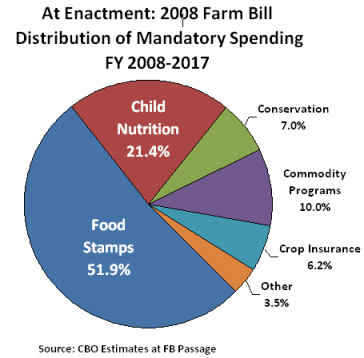
So you may be wondering what the big deal is about the Farm Bill? The Farm Bill is the policy and budget by which most all our food and agricultural production is based. It is a 5 year policy last revised in 2008 so 2012 is the year of its revamping and it is currently creating a lot of discussion with politicians and the media. The vast majority of the funds allocated in the Farm Bill are for food & nutrition programs for the poor,  underserved, and child nutrition like school lunch. The remaining funds go to farm payments, conservation practices, crop insurance, specialty crops, and other agricultural titles. As you can see from the pie chart below, food stamps and child nutrition make up 73.3% of the current 2008 Farm Bill spending.


One of the hot topics and what brought CNN to our farm is the issue of direct payments to farmers. You can see by the pie chart above under the Commodity Programs Title, that direct payments make up 10% of the current spending in the 2008 Farm Bill. Direct payments have been in the Farm Bill since the 1930's. Direct payments have for years been consider the safety net over which we farmers operate. In a vast number of years, the income from farming has often been below the cost it takes us to actually grow the crop. But to ensure a stable food supply, the federal government has essentially underwritten the "floor" of our food by providing direct payments to farmers. In the last 4 or 5 years, grain prices have been good and farm income has improved so there is less need for direct payments, thus the discussion of doing away with them while still providing a farm safety net through enhancing the crop insurance title. There are farmers on both sides of the coin with regards to the issue of direct payments. You'll hear in this video clip aired on CNN that we are in agreement that direct payments should not be part of the 2012 Farm Bill. Our opinion is by giving up direct payments is doing our part for fiscal responsibility to lower the US deficit. We do however strongly advocate for improved crop insurance. 2011 was one of our worst years on record and we would be deeper in debt if we had not purchased crop insurance coverage.

Click the link below to go to the story and CNN video clip:

CNN Farm Bill News Report From Our Farm

So if you watched the video in the link above, you heard my husband say we receive $35,000 annually in direct payments. What you didn't hear that got cut out of the interview was that he continued on to say that the direct payments we receive are used to implement conservation practices to improve the water quality of the Chesapeake Bay Watershed where we live. Let's be clear, direct payments are not pocket money for farmers to go spend. They are re-invested into the farming operation.

Here are some examples:
1. The insurance premium we pay out of pocket for our crop insurance policy on an annual basis surpasses the amount of the direct payment. That does not include our specialty crops like green beans, tomatoes, and winegrapes which are uninsurable in Maryland.
2. The conservation tillage equipment we purchased for protecting our soils from erosion and improving water quality was more than double and triple what we receive in direct payments.
3. The precision agriculture technology we purchased which decreases our fertilizer applications reducing the amount of nitrogen and phosphorus we apply to our fields surpassed what we received in direct payments.
4. Our fuel bill for our fleet of trucks and tractors to get the crops planted, tended, harvested and delivered well surpasses the compensation from the direct payment.

Farming is not a cheap business. It takes capital to grow your food. If you appreciate your safe, healthy, and economically priced food, it is due more in part to the smart efficiency of today's US farm families, and less due to the direct payments of the Farm Bill. That simply gives the Federal Government way too much credit. Let's give credit where credit is due, to the hard working farm families like mine who work to provide you with safe and nutritious food for your family, often inspite of governmental policy and regulations that make farming a challenge.

Wednesday, May 30, 2012

Does Size Matter?

I got you with that title didn't I?

Ever since my trip to New York City with CommonGround, something has been bugging me. Does the size of my farming operation (or anyone else's farm) really matter? When asked by magazine editors we met with what type of farm my family operates,  I usually replied, "we are a 2,000 acre diversified family farm growing grains, hay, fruits, and vegetables." To which I generally got the response "Wow, that's BIG!" I guess I really had never given it much thought. It doesn't seem big to me. Its a family farm. Period. Does it matter what size it is?

Apparently, to some, it does. Big denotes bad in some circles. To us, its a business our family runs. The second generation, my husband's father and uncle, were wise investors in land in our area back in the 50's and 60's. Thus much of the land we farm is owned by members of the family. According to USDA, 98% of all farms in the US are family owned. USDA also defines "small" versus "large" farms based on sales of crops as opposed to land mass. Your a "farm" according to USDA if you earn $1000 or more from your land. That's not hard to do for a active gardener with a small roadside stand, or for goodness sake even a 4H'er who sells their 4H livestock at the end of the season. It has nothing to do with the number of acres farmed or number of animals raised.

Here we are...the board of directors for a "large" family farm. (note sarcasm)

Big also denotes "corporate" in the minds of others. Our family farm is "incorporated" which is simply a means of separating the business from personal assets for tax purposes. I guess that makes us one of those "corporate" farms. Most farms are structured as businesses these days, because that's what they are, businesses. While you may have some romantic notion about farming, let me reassure you, its a heck of a lot of hard work and sacrifice. I think the romance stems from what is perceived as a nice lifestyle. But in reality, the farm will not stay in the family unless it stays in business. A farm will only stay in business if it is profitable.

Farms come in all shapes and sizes. Size does not matter. Size does not define "good" or "bad". We value our land and the food we grow on that land. Whether we had 10 acres or 10,000 acres, we're doing all we can to ensure that the food we eat is safe and nutritious... because the food on our plates at home, is also your food, the food you buy at the store.

Sunday, May 13, 2012

It's SHOW TIME!!

Yesterday kicked of the start of the 4H Livestock shows for our family this year. Both my kids have been involved with 4H since the age of 5, when they were eligible to become "4H Clovers". They started exhibiting bunnies and as they got older, switched to other animals. My son shows pigs and my daughter shows pigs and sheep. They both belong to the "Farm to Market Livestock Club" which is the name of one of the many 4H clubs in our county.

My daughter showing her "spot" breed hog at yesterday's 4H livestock show.

What the kids learn from their 4H animal project is invaluable. They learn all aspects of animal science from nutrition to husbandry to health to genetics. They also learn financial management because they have to keep track of all their expenses and all their income from fair prizes and auction sales in order to complete their 4H recordbook at the end of the year. Most importantly, it teaches them responsibility. The animals are THEIRS. They must take care of them on a daily basis. I may be a mean mom, but my kids lose their iPods and internet access if they do not get their chores done in the morning before school. Their animals are their primary responsbility and therefore come second only to school work.

4H'ers must be knowledgeable about their animals. Here the judge is asking about the various parts of the pig like "Which part does the bacon come from?" or "How much feed does your pig eat per day?" or "How much protein is in your pig's feed?"

In order to do well, their animals must have the proper rate of weight gain, maintain good health, and be trained and worked with. In the pictures above you see the judge in a blue striped shirt. My daughter who is showing must be able to handle the pig in the ring, keep the pig moving so that the judge can evaluate all aspects of the pig, follow proper showmanship techniques, and answer the judges questions about her animal in order to place well.


The lambs must be trained to walk the show ring and hold a show position that best exhibits their features such as length of body or musculature.

 
So by now, you may be wonder why I've not posted any pictures of my son from yesterdays' livestock show. That's because he wasn't there. In addition to being in a 4H livestock club, he is also in our county's 4H Marksmanship club. He had to choose between a livestock show and a rifle match yesterday.


He chose the rifle match!

If you are not familiar with 4H, then you need to check it out. 4H is not just cows and cooking. 4H is a youth development program, administered through USDA. Kids have "projects" that they choose and learn skills needed to complete that project along with leadership, public speaking and community service. There are all kinds of projects including cows and cooking but also rocketry, marksmanship, environmental science and a plethora of other projects youth can choose from. It is not just a rural youth program for farm kids but is also on military bases, after school programs, and urban areas as well. Call your local county extension office to find out about your local 4H programs. It is one of the best youth programs available for kids ages 5-18. 4H was a formative part of both mine and my husband's lives and we are thrilled that it is a legacy that we are passing onto our children.

Thursday, May 3, 2012

My BFF’s: Water & a Thermometer

Odd title I know but I think you will get the gist of what I’m talking about… food safety! I have to say, I have never walked into a grocery store, farm stand or farmer’s market and felt concerned about whether or not the food I’m looking to buy is safe. The one thing that does cross my mind is whether or not the person(s) before me had washed their hands before choosing produce. That’s why water is my best friend in the kitchen. All raw produce that hits my kitchen counter gets well washed. Is it because am I concerned about pesticide residue? Emphatically – NO! I am concerned about the person who used the bathroom without washing their hands before grocery shopping, going to the farm stand or visiting the farmer’s market. Uugghh! Yucky topic I know but reality check here… how many of you have left the bathroom without washing your hands?

Stay with me here, I’m not trying to discourage you from buying fresh produce. I’m trying to illustrate one of the many ways that bacteria can be present on your food and why it is so important to wash all raw produce before eating it. That includes melons which can have bacteria on the rind and which you spread inside to the fruit by cutting the melon without having washed it first. Bacteria can be present from not only people who don’t wash their hands, but from the soil where it was grown, or if it wasn’t kept and stored at a temperature below what bacteria can grow at. Wash, wash, wash is my motto. Here is a video clip from the USDA about safe handling of produce. His opening line hits the nail on the head... Wash Your Hands!!


So a little about pesticides and food safety,

I’m a producer grower. We grow tomatoes, green beans, and winegrapes. These crops make up nearly a third of the acres we farm. This may explain why I am not concerned with pesticide residue. I am the chemical applicator on farm. I hold a commercial license to do so for which I studied long and hard and sat for a lengthy exam to qualify. I’m required to take continuing education credits every single year to maintain that license. I drive the sprayer, mainly for the grapes. I apply only what is needed, when it is needed, and no more than what is needed. I scout and used Integrated Pest Management (IPM) to determine the threshold at which a spray might be needed. We strictly follow the Pre-Harvest Intervals (PHI) for every thing we apply. Every chemical we use, whether organic or conventional, have “pre-harvest intervals” on the label. The pre-harvest interval is the time that must elapse between when the chemical is applied and when the crop can be harvested. This ensures that any residue will be below what the EPA has determined is safe. The label is the legal requirement by which I have to comply. As I have said before, my kids eat what we grow. I am going to put their health first above all other things. To that end, I am entirely comfortable with the fact that our food is safe, which may explain why I’m personally more concerned about people who don’t wash their hands than I am about pesticide residue.

Remember early on when I blogged about “the dose makes the poison”?  Much of what I use for sprays are nutrients – sulfur, copper, manganese, zinc, etc… You probably have these in your multi-vitamin and at that dose, those nutrients are beneficial. Applied in larger doses, those same nutrients are able to control for mildews and fruit rots in various fruits and vegetables. Some times they are organic. Some times they are synthetic. Either way, I am practicing good agricultural procedures, ensuring that our crop is safe to eat.

So onto my other best friend – the thermometer. I use 2 – one in the fridge and one to test the temperature of the food I’ve prepared. I keep our fridge at around 36º F. The FDA recommends below 40º F to ensure food is kept at a temperature below which bacteria can grow and thrive.

I also regularly use a food thermometer to check the temperature of food I’m preparing. I’m actually pretty much a stickler for checking temperatures.  I think it stems from being a dietitian working in both the hospital and nursing home setting. Both places have patients or residents who are already ill or have weakened immune systems and therefore must avoid food borne illness at all costs. Therefore checking food temperatures is almost second nature to me after having practiced in the clinical setting for so long.

My two favorite ways of cooking are using a slow cooker in the winter, and the grill spring, summer, and fall. When grilling, I want to be sure that the meat I’m cooking has reached the minimum internal temperature. USDA recommends all meat – beef, pork, lamb, and veal be cooked to an internal temperature of 145º F,  ground beef, pork, lamb or veal to 160º F, and all poultry to 165º F.  My favorite grilling recipe I will share with you at Thanksgiving time. It is a grilled turkey that has been brined first for 24 hours. If you want the recipe sooner than November, message me J

The USDA defines the “danger zone” as the temperature between 40º F and 140º F which is the ideal range for bacteria to flourish. Food should spend as little time as possible within this temperature range. So when reheating foods, heat it up to 165º F and when cooling food, cool it as quickly as possible to 40º F or below.  Below is a link to a Food Safety Fact Sheet from USDA.


I know that how we grow our produce on our farm is both healthy and safe and am entirely comfortable with my children eating it. I hope you know that by me as a mom keeping my kids health as THE first priority, I am therefore as a woman farmer also keeping your health as first priority. Now, all that I’ve said is not going to necessarily keep you from getting a food borne illness but it will reduce your risk. Your strategic plan – Step 1 wash it, particularly if it is raw produce you’ll be eating; Step 2 – check the temperature of cooked foods. I hope we share the same BFF’s!

Enjoy the fresh produce and grilling season!

Friday, April 27, 2012

Finding Our CommonGround

I just returned from a 3 day trip to New York City volunteering for an organization called CommonGround, (www.findourcommonground.com) a group of farm women whose mission it is to tell folks about what we do (and don’t do) on our farms. Our goal is to connect the face of America’s farmers with the food you all buy from the grocery store. There is a misperception that the food you find in the grocery store is grown by “corporate” farms. Nothing could be further from the truth.

Here is a picture of our “corporation”:


Do you know that 98% of all the farms in the US are family owned & operated?  The bulk of the food you buy at the grocery store, unless it was imported, was grown by an American farm family.

So back to my trip to New York City. Each day was filled radio interviews and deskside meetings with magazine editors, all to promote agriculture and family farms. We got some really interesting questions but three in particular standout to me: During one radio interview, the radio personality asked “So are you the anti-organic agriculture organization?” Oh my goodness no! While I’ve blogged about the similarities between organic agriculture and the way we farm, I believe there is a market for both agricultural systems. My point however, is that studies have not shown that organic farming produces safer or more nutritious foods. The American Journal of Clinical Nutrition published a review of 50 years worth of data which though limited, did not show a significant difference in nutrient value between organic and conventional foods. The nutrient content of food is derived from the nutrient value and quality of the soil. Sustainability is not based on a cookie-cutter system, nor does one farming system “lay claim” to certain practices as being “theirs”. We de-certified our organic ground specifically because it was not sustainable for our operation. I can’t stress enough – you cannot have a cookie-cutter system that applies across all farms. We do not believe in plowing and the susceptibility to erosion that plowing creates. Soil is our farm’s greatest asset. We need to keep it and build it, not expose it and erode it. For that reason, we no longer farm organically. We do use both organic and synthetic chemicals to control for pests and diseases. To us, that is the measure of sustainability, not whether something is organic or conventional. Its a balance of economics and environment, not an either-or situation.

The other episode that surprised me was when I was at our booth at the Editor’s Showcase, which is a tradeshow for editors. A woman approached our booth and said that she no longer ate meat since she watched a video of inhumane treatment of livestock. I responded by asking “You do know that does not represent the majority of family farmers and is not the “norm” for livestock farmers, right?” She said “No, really?” She honestly appeared to be utterly convinced by a single video that the bad apples in farming were representative of all farmers. I am not going to sit here and tell you that all farmers are doing the right thing, just like not all doctors, lawyers, police, or teachers are doing the right thing. But a few bad apples do not represent the entire profession. It was a message that repeated itself several times. Honestly, these were sincere, well-educated people who seemed to have been totally swayed into believing that what they saw on a video was the standard treatment of farm animals. How sad that folks are so disconnected from the farm that they will believe misinformation about an entire profession.

I feel fortunate to have been asked to attend this outreach effort on behalf of CommonGround. If what I said helped one person understand where their food comes from and the faces behind American farmers, then I will have accomplished a great deal.


Another interesting question that came up frequently – who funds you? CommonGround is funded by checkoff dollars from soybean and corn farmers. What this means is that when a farmer sells corn or soybeans, a portion of the sale price of each bushel goes into a fund that pays for research, marketing programs and promotion of those commodities. So American farmers are funding their own progress and programs. A really recognizable use of checkoff dollars is the “Got Milk” mustache campaign, which is a dairy funded checkoff program. It is the soybean and corn farmer checkoff dollars that support the programs of CommonGround, but the women in the organization are all volunteers. CommonGround is funded by farmers, it is our message that we are communicating, and no one else's message.

To find more information about your food and who grows it, I encourage you to visit CommonGround’s website www.findourcommonground.com and watch some of the videos made by other farm women who are also volunteering their time to educate folks about food and farming. It is a great resource to learn about your food.